Where to eat nigiri sushi in Japan
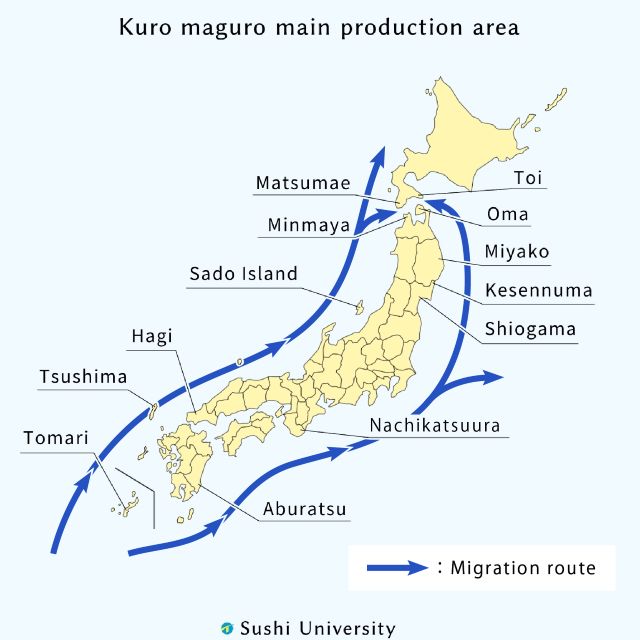
Bluefin tuna migration route
Restaurants serving seafood nigiri sushi can be found all across Japan. Including Japanese restaurants and izakayas, there are said to be around 30,000 establishments nationwide. Although nigiri sushi originated in Tokyo during the Edo period, the Great Kanto Earthquake of 1923 prompted many sushi chefs to leave the capital in search of work. As they relocated throughout the country, they spread their techniques, and nigiri sushi gradually became popular nationwide.
Today, cities especially known for their abundance of sushi restaurants include Sapporo, Sendai, Toyama, Kanazawa, Nagoya, Kyoto, Osaka, Hiroshima, Ehime, Fukuoka, and Saiki. Many of these regions actively promote sushi as a key tourist attraction. In Hokkaido, sushi is sometimes referred to as “Ezo-mae sushi,” echoing the term “Edo-mae sushi.”
Tokyo alone is home to roughly 3,000 sushi restaurants, about 1,000 of which are dedicated sushi specialty shops. With so many options, it’s only natural to wonder which city offers the best sushi experience.
If you’re looking to experience authentic Edomae sushi, Tokyo remains the most straightforward choice. As its birthplace, the city preserves the techniques and philosophy of Edomae sushi more systematically than anywhere else. Moreover, the finest seafood from across Japan converges at the Toyosu Market. Branded bluefin tuna caught off Toi, Hokkaido, is auctioned at Toyosu Market, not Hokkaido’s local markets, before heading to sushi restaurants in Sapporo. This is not an isolated example but an ongoing reality.
While Edomae-style sushi can certainly be found in other regions, many of those versions are adaptations created by chefs trained in Tokyo and adjusted to suit local tastes and conditions. As a result, even restaurants that describe themselves as “Edomae” may differ subtly from the original tradition.
In reality, the types of fish available do not vary dramatically from city to city. Major metropolitan areas such as Tokyo, Osaka, Kyoto, and Nagoya can source nearly identical seafood. The key differences lie in the balance of sweetness and saltiness in the vinegared rice, the flavor profile of the soy sauce, and the specific techniques used to prepare the fish.
For example, in cities such as Kanazawa, Sendai, Nagoya, Kyoto, Osaka, Hiroshima, Ehime, Fukuoka, and Saiki, soy sauces with a slightly sweeter and more umami-forward profile are often used. Very fresh seafood does not always have fully developed umami, and a sweeter soy sauce can help enhance and round out the flavor. By contrast, in Tokyo, Sapporo, and Toyama, a clean, robust dark soy sauce is more common, highlighting the fish’s natural freshness and subtle flavors.
Vinegared rice also varies by region. In the Kansai area, as well as in Nagoya and Hokuriku, there is a tendency to emphasize a smoother texture and gentle sweetness, sometimes achieved by adding a moderate amount of sugar. In Kyoto and Osaka, influenced by the region’s pressed-sushi traditions, a small amount of dashi may occasionally be incorporated. In northern Japan, Tohoku, Shikoku, and Kyushu, acidity is often slightly restrained to better showcase the freshness of the fish. These are, of course, general tendencies; ultimately, the final flavor depends on the individual chef. Even small adjustments to the ratio of vinegar, sugar, and salt can completely transform the character of the rice.
Even more important is how the fish is prepared. Edomae sushi traditionally employs techniques such as curing, marinating, simmering, and aging to maximize umami. In contrast, many regional styles prioritize freshness and firm texture, often serving fish in a state closer to sashimi. Neither approach is inherently superior—they simply reflect different culinary philosophies.
So ultimately, where should you go to eat nigiri sushi?
Many globally acclaimed sushi chefs—including those who hold or aspire to Michelin stars—continue to base their craft on traditional Edomae techniques. However, today many restaurants no longer explicitly display the word “Edomae” on their signage or noren curtains, making it difficult to determine their style at a glance.
Even when sushi appears similar, the underlying philosophy, preparation methods (edomae shigoto), rice design, and soy sauce selection can make it an entirely different experience. Yet these distinctions are not always obvious, as chefs rarely explain every detail to their guests.
If you truly want to experience sushi with a deeper understanding, the key is not simply choosing a restaurant, but learning as you dine. Sushi University’s sushi tours provide detailed explanations of Edomae philosophy, regional variations, fish preparation techniques, and the principles behind sushi rice design. With an interpreter available to answer questions in real time, your experience becomes far more meaningful.
Rather than spending your time wondering where to eat, why not spend it discovering what truly makes sushi exceptional? To turn your sushi experience in Japan into a lifelong memory, consider joining a Sushi University tour.
Applications are accepted through the official Sushi University website. Please select your preferred date and complete the required information on the dedicated form. Once we have reviewed your submission, we will send you further details. If you have any questions, feel free to contact us through the form on the official website.
While Japan has countless sushi restaurants, experiences that combine both understanding and enjoyment are rare. If you are visiting Japan, we hope you will gain insight into its essence, appreciate the regional differences, and take home the philosophy behind sushi. We sincerely look forward to welcoming you.