

Silver-skinned
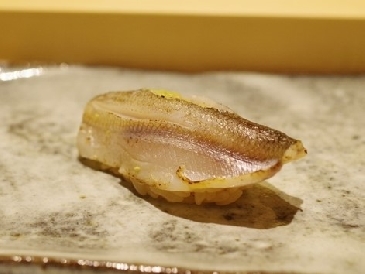

Shishamo
【Nigiri sushi: Hikarimono】
Shishamo is an endemic species of Japan, found only along the Pacific coast of southeastern Hokkaido. Compared to Karafuto shishamo, this species has larger scales, mouth, and eyes, while its adipose fin is smaller. Its body length ranges from 13 to 16 cm.
Interestingly, the catch of shishamo accounts for only about 5% of Japan's consumption. The remaining 95% is imported from Iceland, Norway, and Canada as substitute fish such as capelin (Mallotus villosus (Müller, 1776)) and smelt (Osmerus dentex Steindachner & Kner, 1870).
【The taste of shishamo nigiri sushi】
The term "Hon-shishamo" came into widespread use in the 1970s to distinguish the original shishamo (Spirinchus lanceolatus) from capelin (Mallotus villosus), which began to be imported in large quantities and sold as "shishamo."
Hon-shishamo is available at Toyosu Market, but with an annual catch of approximately 1,300 metric tons, it is considered a luxury fish. As a result, while it may be found in sushi restaurants and traditional Japanese restaurants, it is rarely available at ordinary izakaya or other casual dining establishments.
The fishing season runs from October to November, and only during this period are the freshest fish served as sashimi or sushi toppings. Because they lose their freshness very quickly, the window for enjoying them raw is extremely short.
Fresh hon-shishamo nigiri has a delicate aroma, and with each bite, a rich umami flavor and the sweetness of its high-quality fat spread across the palate. It is one of the rare sushi toppings that can only be enjoyed by those visiting Hokkaido during the brief peak fishing season.
【Related contents】
Capelin
(Updated July 6, 2026)