

Squid and octopus
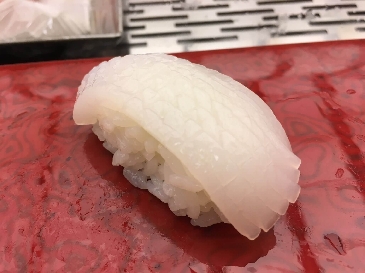

Bigfin reef squid (Aori ika)
【Nigiri sushi: Ika (Squid)】
Bigfin reef squid (Aori ika) has beautiful, translucent flesh that is tender yet pleasantly firm. Its flavor is refined and characterized by a subtle sweetness. This sweetness is believed to stem not only from its relatively high content of free amino acids such as glycine, alanine, and proline, but also from the postmortem metabolism of glycogen stored in its muscles, which contributes to its depth of flavor.
Aori ika has a low catch volume and is considered the highest-grade squid used as a sushi topping. Consequently, at markets such as Toyosu, it generally trades for around $15–$25 per kilogram, and it is not uncommon for large specimens to exceed $70 per squid.
It is said that aging the squid for half a day to a day and a half after ikejime enhances its sweetness and umami, and specimens weighing around 2 kg are considered optimal for sushi. Since the flesh is firmer than it appears, sushi chefs make precise cuts (kakushi bōchō) to sever the muscle fibers, making it easier to eat and bringing out its sweetness. When served as nigiri, it is often accompanied by salt and sudachi, allowing one to fully appreciate its delicate flavor. Additionally, the firm tentacles are sometimes grilled as a snack or glazed with a sweet soy-based sauce.
It is available from spring through late autumn, with peak season in summer. It is rarely found in regular supermarkets, with most of the supply going to sushi restaurants and high-end kappo establishments. With its delicate sweetness and texture, bigfin reef squid is one of the premium sushi toppings that is highly recommended.
Also called Oval squid.
【Note】
A live Aoriika changes its body color shade from black to transparent, but by Ikejime, the flesh remains alive for a while, i.e., colorless and transparent, and the internal organs are visible through it. For those that died without Ikejime or by direct contact with ice, the flesh changes to white, and the internal organs do not show through.
【The umami of bigfin reef squid】
It is often said that Aoriika is more delicious and sweeter after maturing in the refrigerator. The scientific explanation for this is that when fish die, a substance called adenosine triphosphate is broken down into inosinic acid, umami component. In other words, maturing increases umami.
However, in the process of moving from rigor mortis to decomposition, Aoriika and Sumiika have the characteristic that decomposition proceeds only from adenosine triphosphate (ATP), through adenosine diphosphate (ADP), to adenosine monophosphate (AMP).
Since adenosine monophosphate is not a strong umami component like inosinic acid, it cannot be said to increase umami. However, the reason why it is described as an increase in umami may be the combination of glutamic acid, which is inherent in squid, and the AMP produced, which gives the squid a unique flavor.
【Related contents】
What is used as a substitute for the expensive Mongou ika?
List of Squid (Ika) and Octopus (Tako)
(Revision date: June 9, 2026)