
Squid and octopus

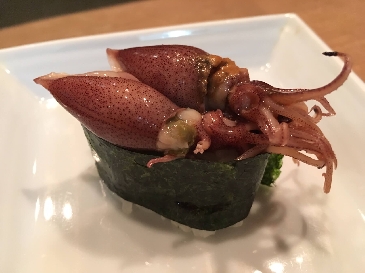
A photo of Hotaru ika nigiri
Firefly squid (Hotaru ika)

Firefly squid (Hotaru ika)

【Nigiri sushi: Ika (Squid)】
Firefly squid (hotaru ika) is found in the Sea of Japan and along the Pacific coast of Japan from Hokkaido southward to Tosa Bay. It inhabits deep waters at depths of 200 to 1,000 meters. Its mantle length is approximately 7 cm. The mantle is slender and cylindrical. Firefly squid is known for its ability to emit a blue-green glow, with hundreds of tiny light-producing organs covering its body.

Firefly squid sushi is served either raw or lightly boiled. Boiled firefly squid is often prepared as nori-obi (wrapped with a strip of nori seaweed) or gunkan-maki and is typically served with ginger rather than wasabi. The umami of its innards, with their subtle bitterness, pairs well with the flavor of nori, while the tender flesh and rich liver flavor fill the mouth.

When served raw, however, the internal organs are typically removed to eliminate the risk of parasite infection (spiruroid larvae). Although this means losing the innards, which are packed with umami, the squid still offers the rich flavor unique to firefly squid. Despite its small size, firefly squid has a pronounced squid-like taste and is one of the sushi toppings that herald the arrival of spring.

The firefly squid is rich in retinol, one type of Vitamin A, with an even higher content than found in beef liver. That means has effects such as helping to maintain the health of the mucous membranes of eyes and skin, making them stronger.

Also called Sparkling enope squid.

【Related contents】
List of Squid (Ika) and Octopus (Tako)

(Updated June 13, 2026)

Main production area

Toyama Hyogo Fukui

Famous production area

Toyama wan

Season

Spring-Early summer