

White flesh
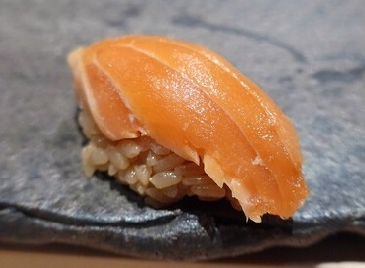

King salmon (Masunosuke)
【Nigiri sushi: Shiromi】
What is Masunosuke?
The Japanese“Masunosuke,”refers to King salmon. King salmon primarily inhabit the Pacific Ocean, particularly the coastal regions of North America from California to Alaska and parts of Asia.
They are anadromous, meaning they are born in freshwater rivers, migrate to the ocean, and return to freshwater rivers to spawn. They are known for their extensive migratory journeys, sometimes traveling thousands of miles. They are the largest of all Pacific salmon species and reach a length of 90 cm.In Japan, some individuals returning to Russia are caught mainly along the Pacific coast of Hokkaido, but their numbers are small. The peak season is from spring to early summer.
With a high fat content, it is definitely the king of salmon when it comes to taste as well. Its high fat content gives it a luxurious, melt-in-your-mouth texture and a rich flavor that is highly sought after by chefs and foodies.
However, high-end sushi restaurants that serve King salmon nigiri sushi are rare. They are occasionally available at places like Sushi Sho and Sushi Takahashi in Tokyo.
【Temperature of vinegared rice (shari) and sushi toppings】
36℃/20~22℃
【Related contents】
List of White flesh fish (Shiromi)
(Revision date: July 2, 2025)
Main production area
Hokkaido
Season
Spring-Early summer