

Shellfish
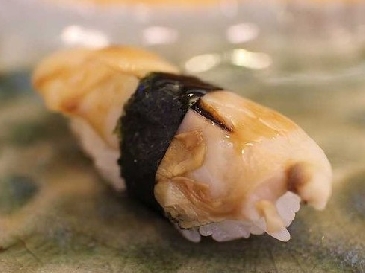

Northern great tellin (Saragai)
【Nigiri sushi: Kai】
Because saragai (Megangulus venulosus) were relatively inexpensive compared with hokkigai, they were commonly used in everyday prepared dishes in their regions of origin. Today, they are distributed throughout Japan, and because they are hardy, they are even shipped live in their shells. They have long been a favorite in regions such as Hokuriku, and they are not uncommon at sushi restaurants in Ishikawa and Toyama prefectures, in particular.
The flesh resembles that of the Ishigakigai, while the foot resembles that of the aoyagi. Its flavor is somewhat mild, so lightly heating it brings out its natural sweetness. It has a pleasant texture and a satisfying bite, and it pairs well with sushi rice.
The name “saragai” derives from the fact that its white, flat shell resembles a ceramic plate. It is also known as “Shirogai,” and in Toyama Prefecture, it goes by the local name “Manjugai.” In the market, it is sometimes sold collectively as “Saragai,” including closely related species such as Arasuji saragai and Beni saragai.
【What is Saragai】
The northern great tellin (Saragai) is found on the Pacific coast from Choshi in Chiba Prefecture northward, and on the Sea of Japan coast from Tottori Prefecture northward on Honshu, as well as in Hokkaido, on the Korean Peninsula, and along the coast of Sakhalin. It inhabits sandy bottoms in the intertidal zone down to depths of 20 meters.
The outer surface of the Saragai shell is glossy white, while the inner surface ranges from white to pale yellow. The foot is yellow to orange-yellow. It is often caught alongside species such as the Hokkigai.
【Related contents】
List of Shellfish (Kai)
(Revision date: September 29, 2026)
Main production area
Hokkaido Aomori
Season
Summer