

Squid and octopus
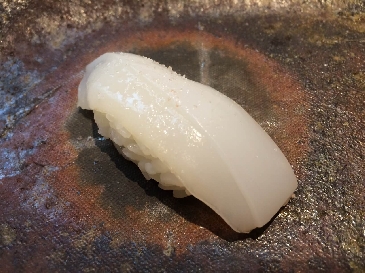

Golden cuttlefish (Sumi ika)
【Nigiri sushi: Ika (Squid)】
Kou ika lives near the sandy and muddy floors in the ocean from Kanto westward, in the East China Sea.
Kou ika (golden cuttlefish) is often seen in markets stained with ink, as its ink sac is large and prone to rupture. Because of this appearance, it is also known as “sumi ika” (ink squid). It is one of the representative squid species long prized in Edomae sushi.
Its flesh is an exceptionally clean white, with a pleasant elasticity and a crisp bite that gently gives way in the mouth. Unlike some squid varieties, it is typically not scored with elaborate knife work and is simply served as nigiri, allowing diners to fully appreciate its natural texture.
Rather than pronounced sweetness, sumi ika is valued for its refined umami and crisp texture. Unlike the rich, almost cloying sweetness of aori ika, it is defined by an understated and elegant flavor profile. In Edomae sushi, there is a longstanding philosophy that prioritizes the natural texture, aroma, and bite of seafood over overt sweetness, and sumi ika has long been regarded as an ingredient that embodies this sensibility.
In late summer, juvenile specimens known as “shin ika” appear on the market, and their tender flesh is highly prized by sushi connoisseurs. By contrast, in winter the flesh becomes firmer and the umami deepens further. When served as nigiri, its flavor is often enhanced with a touch of salt or citrus such as sudachi, which helps bring out a subtle sweetness in harmony with vinegared rice. Some restaurants also add a light accent of shiso leaf or nori to introduce a gentle aromatic note.
It may be a personal observation, but in Tokyo sushi restaurants, sumi ika seems to be used more frequently for nigiri than aori ika or kensaki ika.
【Trivia】
・Squid has three layers of skin and the third layer can be eaten. The taste is the same whether the skin is peeled off or not. But if the time is taken to peel off the last layer of skin, it can be cut smoothly and the texture on the tongue is soft.
・The taste of the cuttlefish depends on the sweetness, richness and texture. Bigfin reef squid has a high glycine content so the sweetness is emphasized, but golden cuttlefish has a low glycine content, so the sweetness is more subtle compared to Bigfin reef squid. It does have a rich flavor because of the high taurine content.
・Cephalopods such as squids (Ika) and octopus (Tako), or shellfishes such as abalone (Awabi) don't contain any inosinic acids, so it won't make any difference in the taste if you let them rest overnight. This is because squid and shellfish do not have the enzyme ADA, and AMP does not break down into inosinic acid even after death. Squid contains almost no inosinic acid, but the unique umami flavor is created by combining the glutamic acid and adenylate (AMP) contained in squid. AMP (adenylate) has a weaker umami flavor than inosinic acid, but when combined with glutamic acid, it creates a unique flavor.
【Related contents】
What is used as a substitute for the expensive Mongou ika?
What is Geso?
List of Squid (Ika) and Octopus (Tako)
(Updated June 8, 2026)
Main production area
Seto Inland Sea Mikawa Bay Kyushu
Famous production area
Season
Autumn-Spring