

White flesh
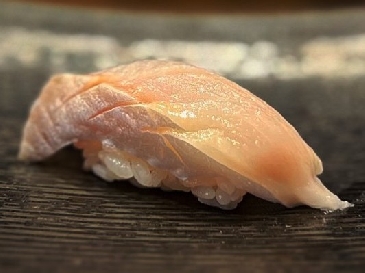
Okhostk atka mackerel (Hokke)
【Nigiri sushi: Shiromi】
Okhostk atka mackerel (Hokke) is a fish of the greenling family(Hexagrammidae), characterized by its high fat content. It has a melt-in-your-mouth texture and a distinct sweet, fatty flavor, along with a pleasant aftertaste, making it an excellent match for vinegared rice. While it is eaten as sashimi in its region of origin, such as Hokkaido, it is rare as a sushi topping even there.
Since hokke loses its freshness quickly, much of the hokke that enters the market is processed into products such as dried fish. The variety widely eaten as grilled fish is called “shima-bokke,” with most of it sourced from Russia and Alaska. By contrast, sushi restaurants primarily use “ma-bokke,” which is caught mainly in Hokkaido and other parts of Japan, for nigiri sushi.
Hokke is one of Hokkaido’s representative marine resources, but catch volumes have declined to about 15 percent of their peak levels. In response to this decline in wild stocks, hokke are being raised in underwater cages in areas such as Matsumae Town in southern Hokkaido. Wild-caught hokke are held there for a certain period before being shipped.
Furthermore, as a production method that does not rely on wild fish, Shiraoi Town is experimenting with closed-loop land-based aquaculture, in which fish are raised from artificial fertilization and hatching. Although the project is currently still at the stage of verifying rearing techniques and profitability, research is underway to develop this as a new production method for ensuring a stable supply of hokke amid declining natural resources.
【What is Hokke】
Okhotsk atka mackerel (Hokke) is distributed throughout the Sea of Japan north of Tsushima, along the Pacific coast north of Ibaraki Prefecture, the Yellow Sea, Primorsky Krai, the Sea of Okhotsk, and around the Kuril Islands. In Japan, it is most commonly caught in Hokkaido. It inhabits rocky reef areas from coastal waters to depths of about 100 meters offshore. Its body is spindle-shaped. Total length ranges from 20 to 50 cm. It has five lateral lines. The body is dark brown or dark green, with indistinct mottling extending from the back to the sides.
The peak season varies by region: Rebun Island is best from July to August, Rausu from October to November, Hidaka from November to December, and Shakotan from April to May.
Okhotsk atka mackerel (Hokke) mainly occurs in two types: “Ma-hokke(Ma-bokke)” and “Shima-hokke(Shima-bokke).” Ma-bokke refers to Hokke caught in Japan, with the vast majority harvested in Hokkaido. Shima-bokke, on the other hand, is characterized by its striped pattern and inhabits the cold northern Pacific, including the Bering Sea and the Sea of Okhotsk. Domestic catches in Japan are extremely low, and most of the Shima-hokke available on the Japanese market are imported from Russia, the United States, and other countries.
Hokke are migratory fish that typically move in schools across the ocean in cycles. However, some true Hokke settle and live around nearby rocky reefs; these are called “Ne-bokke.” Ne-bokke that remain in these nutrient-rich environments as they grow can reach lengths of 60 cm and weights of over 2 kg, developing plump bodies with exceptionally high fat content. Hakodate, Rausu, and Rebun are known as major production areas.
【Related contents】
List of White flesh fish (Shiromi)
(Revision date: October 1, 2026)
Main production area
Hokkaido
Season
May–July, November