

Fish roe
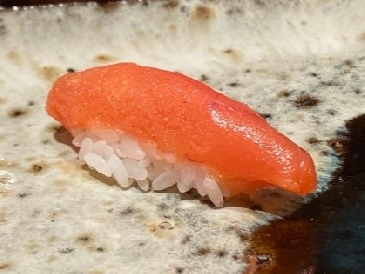
Pollock roe (Tarako)
【Nigiri sushi: Gyoran】
In Japanese coastal waters, three species are distributed along the northern Japanese coast: Madara (Pacific cod), Sukesoudara (Alaska pollock), and Komai (Saffron cod). The ovaries of Madara (Pacific cod) are called “mako,” while those of Komai (Saffron cod) are called “komai-ko.”It's not tarako because it's cod roe (Madara/Tara); it's actually pollock roe (Sukesoudara).
The mentaiko everyone knows comes from the Korean name for Alaska pollock, “明太” (myeongtae), hence the name mentaiko. To elaborate further, tarako is the salted roe of Alaska pollock, while mentaiko is the salted roe of Alaska pollock seasoned with a marinade containing ingredients like chili peppers. In other words, the names are distinguished based on the presence or absence of chili peppers.
However, recently, the common understanding is that tarako refers to the unsalted, non-spicy version, while mentaiko refers to the version seasoned with a spicy marinade, meaning “mentaiko = karashi (spicy) mentaiko” is often how it's used.
Sushi chefs don’t usually use processed ingredients like tarako (salted pollock roe) as toppings. That said, if a chef prepares the roe themselves—removing it from fresh Pacific cod, seasoning it, and curing it—it may occasionally be served. Traditionally, tarako was eaten raw as a side dish with rice or grilled as a filling for rice balls. In recent years, however, it has started appearing as nigiri at conveyor-belt sushi restaurants, where its popularity seems to be growing. The slightly sweet vinegared rice pairs surprisingly well with its bold saltiness.
Hokkaido produces about 60% of Japan’s total tarako and has long been known for its high quality. Because the roe is processed immediately after being harvested from Alaska pollock caught in Hokkaido—often salted right away—it typically avoids freezing and thawing. This helps preserve its natural flavor at its best.
In Hokkaido, some restaurants serve tarako sushi only during the winter season. Nigiri may be finished with a sprinkle of white sesame seeds or a touch of yuzu zest. For gunkan-maki, the thin membrane is removed and the roe is crumbled before being placed on top. Interestingly, wasabi doesn’t pair particularly well with tarako, so many chefs use little to none.
To be honest, higher-end sushi restaurants that serve pieces one by one rarely offer tarako. It’s generally not something you would order in that setting.
【Related contents】
List of Nimono, Gyoran and Others
Main production area
Hokkaido
Season
December – February