

Shellfish
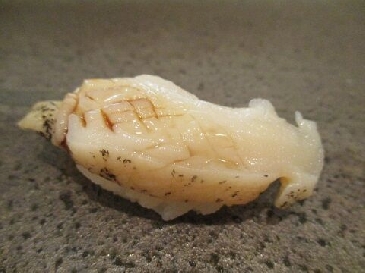

Finely-striate buccinum (Shirobai)
【Nigiri sushi: Kai】
Bai (Babylonia japonica) is a marine gastropod of the family Babyloniidae that inhabits sandy-mud bottoms in shallow coastal waters and is commonly known as “baigai.” It is also called “kurobai” or “honbai” and is often enjoyed as a delicious appetizer, typically boiled in salted water, simmered in soy sauce, or steamed with sake.
On the other hand, the term “baigai” used in sushi restaurants and markets also includes gastropods of the family Buccinidae, which is distinct from the family Babyloniidae. A prime example is “shirobai,” which is popular as a sushi topping along the Sea of Japan coast. “Shirobai” is not a formal taxonomic group but rather a regional or commercial name. At sushi restaurants, it is common to refer to Etchu-bai (Buccinum striatissimum)—which is landed in large quantities—as “shirobai.”
Shirobai meat is a lustrous white reminiscent of white porcelain, characterized by a crunchy texture and an elegant sweetness. Its subtle bitterness becomes more noticeable as you chew. In nigiri sushi, it is typically enjoyed for its distinctive texture. However, steaming it with sake softens the meat just enough, allowing it to blend well with vinegared rice. Additionally, briefly simmering it in kombu broth during preparation adds umami to its mild flavor.
While it is not a common sushi topping in the Kanto region, it is relatively common in sushi restaurants in the Hokuriku region, such as Kanazawa. The word “bai” in “baigai” is sometimes associated with the idea of doubling good fortune, so it is occasionally considered an auspicious food.
Main production area
Shimane Yamaguchi Fukui Kyoto
Season
Winter