

Shellfish
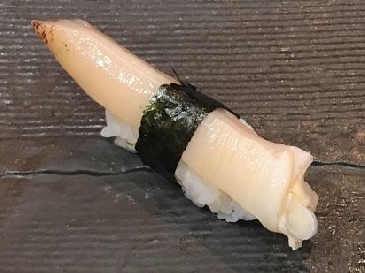
Japanese geoduck (Shiromiru)
【Nigiri sushi: Kai】
The official name of Mirugai (Tresus keenae) is Mirukui. In sushi restaurants and fish markets, however, it is generally called Mirugai.
The part used as a sushi topping is the siphons that extend far from the shell, and only about two to four pieces can be obtained from a single shell. Due to overfishing and the deterioration of its habitat, wild stocks have declined. Although it is still caught in areas such as the Seto Inland Sea and Mikawa Bay, landings are extremely limited. As a result, wild Mirukui is considered a very rare and expensive sushi topping.
However, many conveyor-belt sushi restaurants offer "Mirugai" at relatively reasonable prices. Moreover, the meat often appears whiter than that of wild Mirugai. In fact, much of it is the Japanese geoduck, or Namigai (Panopea japonica), commonly known as Shiromiru. It is harvested mainly in Aichi and Chiba Prefectures, and because its siphon is whiter and thicker than that of Mirugai, it came to be called Shiromiru.
Shiromiru is enjoyed less for its rich umami than for its crisp, fibrous texture and mild, refined flavor. Although its taste is relatively delicate, lightly searing it adds a toasty aroma that brings out its subtle umami and natural sweetness.
However, catches of Shiromiru have also been declining in recent years. To compensate for this shortage, large quantities of Pacific geoduck (Panopea generosa), also known as king clam, are imported from Canada and the United States. At Toyosu Market, this imported species is also sold as Shiromiru and is widely used in sushi restaurants. In recent years, prices have risen due to declining import volumes and increasing demand, and what was once considered a substitute shellfish is now becoming a premium sushi topping.
(Revision date: July 15, 2026)
Main production area
Aichi Chiba
Season
Spring