

Silver-skinned
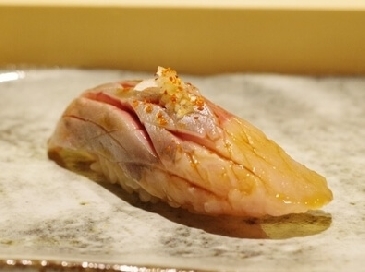

Pacific herring (Nishin)
【Nigiri sushi: Hikarimono】
Hokkaido has a long-standing culinary tradition of using Nishin (Pacific herring) as an ingredient, and it has long been enjoyed as sashimi and sushi. In recent years, it has become more widely available at Hokkaido-style conveyor-belt sushi restaurants, and it is now appearing on menus in Honshu as well. It is also increasingly being served as a seasonal topping at counter-style sushi bars.
Nishin has a great many small bones, so if it is cut thickly like standard sushi toppings, the bones are likely to get in the way when eaten. On the other hand, the flesh is tender, and attempting to carefully remove each bone individually can cause it to fall apart easily, requiring advanced preparation skills. For this reason, some restaurants prepare it by slicing the flesh thinly on the diagonal or making fine cuts with a knife—similar to the technique used for preparing hamo—to sever the small bones. Through such techniques, they minimize the presence of small bones while bringing out the rich, fatty umami unique to Nishin.
The flavor is characterized by the umami and sweet richness of fat typical of blue-backed fish, yet it is relatively easy to eat; particularly fatty specimens are sometimes described as being “like toro.” While fresh, raw nigiri is especially highly regarded, Nishin loses freshness quickly, so it is often served marinated in vinegar. Nishin nigiri, long known as a traditional Hokkaido sushi topping, has become increasingly available outside Hokkaido in recent years thanks to advancements in artisanal techniques and distribution.
The North Pacific, the Sea of Japan, and the northern Yellow Sea are home to the Pacific herring (Clupea pallasii). Meanwhile, the Atlantic herring (Clupea harengus) is found in the northern Atlantic Ocean.
Also called California herring or Eastern herring or North pacific herring or Oriental herring or Herring.
【Fat Content, Amino Acids, and Freshness Evaluation in Herring】
The umami of herring is mainly due to the high-fat content in the meat, but the concentration of free amino acids, especially histidine, increases in season. When purchasing herring, it is advisable to select herring with few scale-offs, with a distinctive luster to the skin, and with a belly that has not been cut. Blood in the eyes is not a good indicator of freshness, as the fish often bleeds internally during the catching process.
【Related contents】
Herring roe (Kazunoko)
List of Silver-skinned fish (Hikarimono)
(Revision date: May 25 2026)
Main production area
Hokkaido
Season
Winter