

Prawn and crab
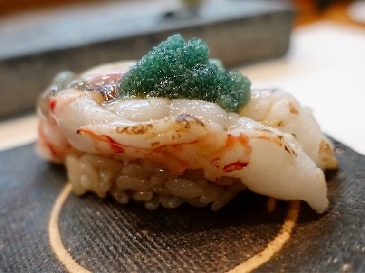

Botan shrimp (Botan ebi)
【Nigiri sushi: Ebi/Kani】
What is Botanebi?
Botan ebi lives at depths of about 200 to 500 meters in cold seas. The higher the temperatures of the water, the deeper they live. They used to live in many places in the Pacific Ocean south of Hokkaido’s Funka Bay, but they’ve become scarce in Hokkaido and Toyama, so Japan mostly relies on imports from Russia and Alaska. This beautiful shrimp is reminiscent of a peony flower, hence the name.
What does Botanebi (Botan shrimp) nigiri sushi taste like?
Botan shrimp (botan ebi) are prized for their rich sweetness, which is often considered more pronounced than that of sweet shrimp (ama ebi), as well as for their luxurious flavor and pleasantly firm texture. They are among the most expensive shrimp served raw, and specimens landed in Hokkaido and other northern regions can sell for more than US$50 each. Interestingly, like sweet shrimp, botan shrimp are not necessarily at their best immediately after being caught. Allowing them to rest for a period of time after harvest enhances both their sweetness and texture, resulting in a more enjoyable eating experience.
When prepared as nigiri sushi, sweet shrimp are often served in pairs, whereas a large, plump botan shrimp is typically served as a single piece. Because the flesh is extremely delicate, sushi chefs must handle it with great care to avoid damaging its texture. Some restaurants garnish the nigiri with the shrimp’s shimmering blue-green roe (sotoko), while others use the roe on its own to make gunkan-maki. The sushi may be finished simply with a squeeze of sudachi and a sprinkle of salt, or the shrimp may be lightly cured with kombu to enhance its natural umami.
Many diners also enjoy the head, and it is perfectly acceptable to suck out the rich shrimp miso from inside.
When sushi chefs and seafood dealers refer to botan shrimp, they are often talking about Toyama shrimp. At Toyosu Market, this species is commonly known as “Tora-botan” (“Tiger Botan”) because of the tiger-like stripes on its shell. By contrast, the original botan shrimp species is known as “Hon-botan” (“True Botan”).
Toyama shrimp are widely distributed throughout the North Pacific, ranging from the Sea of Japan north of Toyama Bay and the waters off Hokkaido to the Sea of Okhotsk and the Bering Sea. They inhabit sandy and muddy seabeds at depths of approximately 100 to 350 meters and can grow to about 20 centimeters in length.
In seafood markets, both the original botan shrimp and the Toyama shrimp are commonly sold as “botan shrimp,” which often confuses. Although the two species look remarkably similar, the original botan shrimp lacks the distinctive white markings on the head that characterize Toyama shrimp, making them relatively easy to tell apart once you know what to look for.
Scientific name: Pandalus nipponensis (Yokoya, 1933), Pandalus hypsinotus Brandt, 1851
【Temperature of vinegared rice (shari) and sushi toppings】
36~38℃/18~20℃
【Related contents】
What is Spot prawn?
There are strangely two types of Ama ebi
List of Prawn (Ebi) and Crab (Kani)
(Revision date: June 8, 2026)