

Simmered
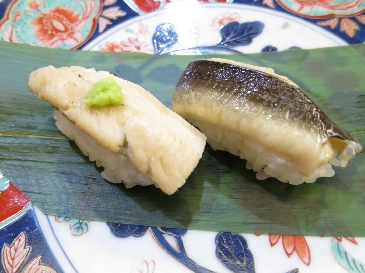
Japanese conger eel (Anago)
【Nigiri sushi: Nimono】
More than 20 species of anago have been identified worldwide. Among them, the most commonly used for sushi are Goten-anago (Silvery conger) and Kuro-anago (Beach conger), which are found mainly in southern Japan, and Ma-anago (Japanese conger eel), which is said to be the most suitable for nigiri sushi. When anago is mentioned in Edomae sushi restaurants, it refers to Ma-anago.
There is an old saying that “The best Conger eel is from Edomae (the old name for Tokyo Bay)” and even now, the conger eel found in the seas off of Haneda (in front of Tokyo International Airport), is considered to be high quality, but they are not available in high quantities and aren’t often put on the market. However, besides the seas off of Haneda, the conger eel found in Tokyo Bay, such as in Kanazawa-hakkei, Kanagawa prefecture, or Kisarazu and Futtsu, Chiba prefecture, also have good flavor. Conger eel itself is found throughout Japan, from Hokkaido southward. They are often caught in Tsushima, Nagasaki prefecture and the Seto Inland Sea. In recent years they are also imported from South Korea and China.
This is one topping that can be enjoyed year-round, but is especially delicious from June to July when the conger eel is fattier. This is said to be because the rainy season allows nutrients to flow through the rivers into the sea, increasing the food supply and making the eel more delicious. It is interesting that although grilled conger eel is made into sushi at Kansai sushi restaurants, boiled conger eel is the general topping in Kanto.
When Yohei Hanaya, the founder of Edomae-style sushi, first opened shop, it is said that he added boiled conger eel as a topping when he added clams and tiger prawns as toppings. Since conger eel has been used as a sushi topping since Edomae-style sushi was born, special attention to detail is given in the preparations, and each shop comes up with its own unique flavor.
What does Anago (Japanese conger eel) nigiri sushi taste like?
When you put simmered Anago in your mouth, it melts delicately, and its fine fat gently coats your tongue. It can be enjoyed simply with salt or brushed with sweet Tsume sauce. In nigiri sushi, the Anago may also be lightly seared, allowing the rich fat to melt pleasantly in your mouth.
The small opening located in the middle of the body—the navel (actually the anus)—marks the boundary between the upper section near the head and the lower section toward the tail. Fat is more evenly distributed in the upper section, while the lower section is said to have a firmer texture because it moves more. Traditionally, sushi chefs often said, “Serve the upper section skin-up and the lower section skin-down.”
“Skin-up” means the skin side faces upward, and the flesh rests on the rice, while “Skin-down” means the flesh faces upward and the skin is placed against the rice.
Because Anago becomes extremely tender after simmering, it can easily split apart. If nitsume sauce is brushed over cracked flesh, the sauce seeps into the gaps and affects the appearance. However, unless the splitting is especially noticeable, both the upper and lower sections are commonly prepared skin-down in modern sushi shops.
Also called White-spotted conger or Conger eel or saltwater eel.
【Temperature of vinegared rice (shari) and sushi toppings】
38~40℃/36~38℃
【Preparation method】
The traditional preparation method is to boil the conger eel without removing the slime from its surface. However, different sushi chefs use different methods of preparation, such as removing the slime after the conger eel has been cleaned.
【Substitute fish】
Punctuated snake-eel: Ophichthus remiger
Kaup's arrowtooth eel: Synaphobranchus kaupii Johnson, 1862
Deep-sea fish, Ira-anago (Kaup's arrowtooth eel), is now widely distributed mainly in supermarkets in the Tokyo metropolitan area. As the catch of Japanese conger (Ma -anago) has been drastically reduced, it has come into the limelight as a "substitute" fish.
【Related contents】
There are two ways to make anago nigiri sushi, “skin-up ” and “skin-down”.
Why are two pieces of nigiri sushi made at once?
What is Noresore sushi?
List of Nimono, Gyoran and Others
(Revision date: May 8, 2026)
Main production area
TokyoBay Kyushu
Famous production area
Season
Summer