

Simmered
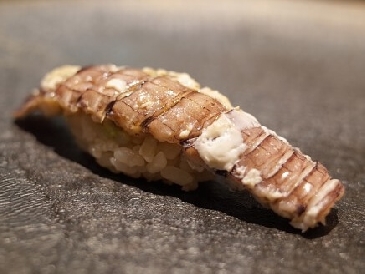

Japanese mantis shrimp (Shako)
【Nigiri sushi: Nimono】
They look grotesque, and I really can’t bring myself to eat them. However, the Japanese mantis shrimp (Shako) is a prime example of a food where there’s a huge disparity between its appearance and its taste. That said, its general composition is similar to that of shrimp, and its umami and sweetness are virtually indistinguishable from those of shrimp. Its fat content is around 3 percent, which is only slightly higher than that of shrimp.
Sushi chefs typically source shako that has been “hamayude,” a method in which the shrimp are boiled where they are landed immediately after being caught. This is because once shako die, their flesh begins to dissolve due to autodigestion. Therefore, boiling them while they are still alive in the area where they are landed generally results in better-quality meat.
The salt-boiled flesh has a unique texture distinct from that of shrimp, and its indescribably rich aroma is irresistible. While late autumn, just before molting, is one peak season, shako caught from early spring through early summer, when they are full of roe, are considered the very best. The roe, known as “katsubushi,” is exquisite.
At sushi restaurants, egg-bearing shako are served as an appetizer with sake, while the males are used as sushi toppings. This is because the males have a stronger umami flavor, and since they lack eggs, their flesh blends more easily with the sushi rice when made into nigiri. When seasoning the nigiri after shaping, chefs may choose between “tsume” (a sweet sauce), “nikiri” (a soy-based sauce), or salt, depending on the condition of the shako and the customer’s preferences. As for temperature, chefs adapt flexibly, serving it at room temperature or lightly searing it.
This is just our personal opinion, but considering how well it pairs with sushi rice, we’d say shako is best enjoyed in early autumn, when the flesh becomes firmer, rather than during the egg-laying season. The reason is that its dense texture, distinct from that of other shrimp, makes for a satisfying bite, and its wild umami and unique aroma are simply irresistible. Additionally, sushi chefs sometimes remove the meat from the legs, known as “shako tsume (shako claws),” and serve it separately. It has a particularly strong sweetness, making it a favorite among connoisseurs as a sake accompaniment, and it’s sometimes used as a luxurious filling for gunkan-maki.
In the past, mantis shrimp were caught in large quantities in Tokyo Bay and were a popular, everyday sushi topping. However, due to factors such as development and overfishing, catches plummeted, eventually leading to a fishing moratorium. Production subsequently shifted to Mikawa Bay and the Seto Inland Sea, but catches have been declining in these regions as well. Today, Otaru in Hokkaido is the primary production area.
【What is Japanese mantis shrimp】
Shako (Japanese mantis shrimp) is distributed from the coast of Japan south of Hokkaido to Taiwan and the northern coast of China. It inhabits the intertidal zone of inner bays and sandy mud at depths of 10 to 30 meters. Although it resembles a shrimp, it is completely different from shrimp, with a pair of large, sickle-shaped second legs and compound eyes that protrude forward. It can reach a total length of 20 cm.
【Related contents】
List of Nimono, Gyoran and Others
(Revision date: September 15, 2026)
Main production area
Setonaikai Ariakekai
Famous production area
Koshiba Otaru Nanao Mikawa Bay kanonji
Season
June-July