

Sushi roll (Makimono)
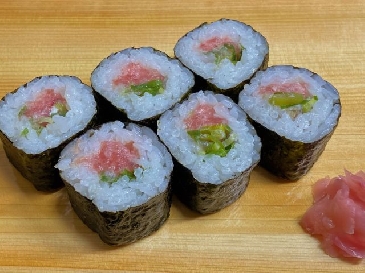
Minced tuna roll (Negitoro maki)
【Makimono】
Minced Tuna Roll (Negitoro Maki) is a sushi roll made by wrapping vinegared rice and negitoro in nori. Although it is typically prepared as a thin roll (hosomaki), some sushi restaurants also serve negitoro maki as a medium-sized (chumaki) or thick roll (futomaki). In addition to negitoro maki, negitoro is also commonly served as gunkan-maki (battleship-style sushi) or as negitoro-don (a rice bowl topped with negitoro).
There are various theories regarding the origin of the name "Negitoro," but the most widely accepted one is that it derives from the process of scraping off (negi-toru) the flesh clinging to the central bone of the tuna. It is believed that the term negi-toru gradually evolved into "Negitoro." In other words, the original meaning of "Negitoro" refers to nakaochi (the meat scraped from around the tuna's central bone) and not to a dish made with negi (green onions) or toro (fatty tuna).
Negitoro is said to have been created in 1964 at Kintaro Zushi, a long-established sushi restaurant in Asakusa, Tokyo. Originally, it was a staff meal made using nakaochi.
Today, in sushi restaurants, negitoro generally refers to finely chopped or pounded tuna trimmings—pieces unsuitable for nigiri sushi—mixed with chopped green onions. In high-end sushi restaurants, it is sometimes prepared by hand from generously pounded bluefin tuna toro.
On the other hand, the inexpensive negitoro sold in supermarkets and other retail stores is typically made by blending tuna trimmings and offcuts with vegetable oils, processed edible oils, fish oil, and other ingredients to create a smoother texture and enhance the rich umami of the fat. Although its ingredients and preparation methods differ from those used in sushi restaurants, it is widely enjoyed as a filling for negitoro maki and other sushi, offering a convenient way to enjoy the flavor of tuna.
(Revision date: July 29, 2026)