

Prawn and crab
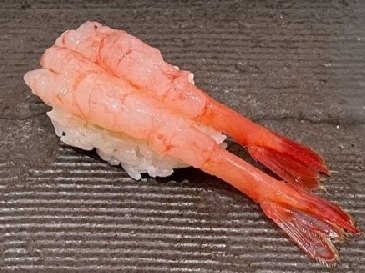

Sweet shrimp (Ama ebi)
【Nigiri sushi: Ebi/Kani】
What is Ama ebi?
Just as the name suggests, amaebi has an elegant sweetness (‘ama’ means sweet in Japanese). Amaebi is actually just an alias for this shrimp and the official name is “Hokkoku akaebi (Alaskan pink shrimp or northern pink shrimp)”. Amaebi is found along the Japan Sea coast from Toyama Bay northward, and on Hokkaido coasts. They are about 10 cm long and live up to 1000 meters deep in the sea and spawn once every two years. The umami increases from autumn to winter and the egg-retention period is from January to February. This is the time to try the emerald-green eggs (which turn black as they lose freshness) with the shrimp.It has many fans for its appearance, which shines with an emerald green color, and its popping texture.
These prawns transform themselves into females altogether when they reach the age of six years old. The ones in midst of the transformation period are very expensive. The ones left aside the whole day after caught are considered tastier than fresh alive ones.
What does Amaebi (Sweet shrimp) nigiri sushi taste like?
Sweet shrimp (Ama ebi), as the name suggests, are known for their delicate sweetness. In many regions, they are in season from fall through winter, and their umami flavor intensifies during this period.
Females that spawn in spring carry their eggs for an extended period. During winter, many can be seen carrying blue-green eggs externally. These emerald-colored eggs are also prized for their popping texture.
In nigiri sushi, sweet shrimp may be served as either a single shrimp or two shrimp per piece, depending on their size. Some sushi chefs also remove the tail before shaping the nigiri.
The primary component responsible for the sweetness of sweet shrimp is glycine, a type of amino acid. Their unique sticky texture, on the other hand, is believed to come from their high content of water-soluble glycoproteins.
Interestingly, sweet shrimp do not contain significantly more glycine than other shrimp species. However, because they are rich in glycoproteins, the flesh has a naturally sticky consistency. This allows the sweetness to linger on the palate longer, making it seem more pronounced.
Because sweet shrimp contain a high amount of moisture, the flesh tends to shrink when heated, and the texture also deteriorates. This is believed to occur because the glycoproteins denature during cooking and lose their original properties. For this reason, sweet shrimp are most commonly enjoyed raw, either as sashimi with wasabi soy sauce or as a sushi topping.
Freshly caught live sweet shrimp have firm flesh and a pleasant texture, but they contain very little noticeable sweetness. In addition, they may retain a slightly fishy odor if eaten immediately. For this reason, they are typically chilled in ice water before being served.
Imported frozen sweet shrimp—primarily Northern shrimp (Pandalus borealis)—are widely available on the market. Major producing regions include Russia, Canada, and Greenland. Conveyor-belt sushi chains often use these frozen imported products, and processing such as shelling may be carried out overseas in countries such as China and Vietnam.
In recent years, advances in onboard freezing technology have improved the quality of frozen products considerably. Nevertheless, domestically harvested fresh sweet shrimp are generally regarded as superior in both aroma and texture.
Note: From a biological and fisheries perspective, Pandalus eous Makarov, 1935—commonly sold in Japan as “Ama ebi”—is also known in English as the Alaskan pink shrimp or Pacific pink shrimp. A very closely related species found in the North Atlantic, Pandalus borealis Krøyer, 1838, is commonly called the Northern pink shrimp or simply Northern shrimp in English-speaking countries. However, because these names are rarely used in sushi restaurants or Japanese culinary contexts, this article adopts the translation “Sweet shrimp (Ama ebi).”
【Related content】
There are strangely two types of Ama ebi
List of Prawn (Ebi) and Crab (Kani)
(Updated May 29, 2026)