

Shellfish
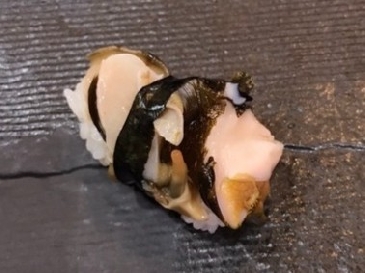
Turban shell (Sazae)
【Nigiri sushi: Kai】
Sazae, Turbo sazae H. Fukuda, 2017, commonly known as the Horned Turban or Turban Shell, is found on rocky reefs from the intertidal zone to depths of about 10 meters throughout Japan, except in northern Hokkaido and Okinawa.
The shell can reach a height of up to 10 cm. It is thick and conical, with characteristic spines around its periphery. The number and length of these spines vary considerably depending on habitat and individual growth conditions. The gonads are yellowish-white in males and green in females.
Sazae harvested during the summer are often less desirable because they lose condition after spawning. As a result, winter and spring are generally considered the best seasons for enjoying them.
Sazae feed primarily on seaweed, and both the flavor of the flesh and the color of the shell are said to be influenced by their diet. It is traditionally believed that feeding on arame seaweed gives the shell a lighter, whitish appearance, while feeding on tengusa seaweed results in a darker, blackish-brown coloration.
The flesh of sazae is firm and can be challenging to use as a nigiri sushi topping. Its appearance is not always particularly attractive, and its strong oceanic aroma and intense umami can sometimes disrupt the overall balance of the sushi. Nevertheless, some diners highly appreciate its wild character and rich flavor.
When preparing sazae for nigiri sushi, chefs often make fine hidden cuts (kakushi-bōchō) on the inner side of the flesh to improve its texture and make it easier to chew. Fresh viscera can be briefly blanched and served as a topping, offering a pleasant bitterness and rich flavor.
Many Japanese people may prefer Sazae-no-Tsuboyaki (grilled turban shell in its shell), which combines the aroma of caramelized soy sauce with the distinctive oceanic fragrance of sazae.
【Related contents】
List of Shellfish (Kai)
Season
Summer