

White flesh
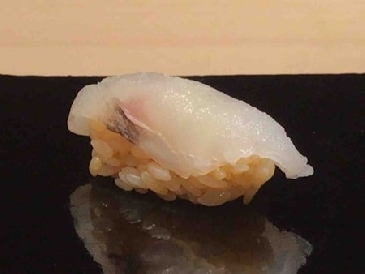
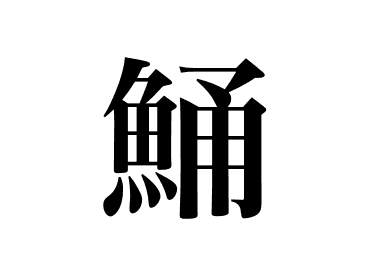
Bartail flathead (Magochi)
【Nigiri sushi: Shiromi】
Kochi (whose standard Japanese name is Magochi) is a high-quality white-fleshed fish that is prized in summer. It was once used primarily in high-end traditional Japanese cuisine, and its use as a sushi topping is relatively recent. Its flesh is translucent and contains gelatin, earning it the nickname “summer pufferfish.” Unlike suzuki and hoshigarei, which are available from May through August, kochi is prized for its crisp, firm texture. When thinly sliced and served as nigiri, it offers a pleasant crunch and the delicate, mild flavor of its flesh. It can be enjoyed with ponzu or irizake, a traditional Japanese seasoning made by simmering sake with other ingredients, for a refreshing taste, or cured with kombu to develop a deeper flavor. In addition to the flesh, the skin, roe, and milt are also edible.
Kochi is also a fish that can challenge sushi chefs. Because it has a large head, the proportion of the fish that can be used for sushi toppings is relatively small, and numerous small bones must be carefully removed one by one during preparation. Furthermore, because its flesh is relatively firm, the chef must determine the optimal aging time, taking both texture and umami into account. The meticulous preparation and careful judgment required to age the fish properly make kochi one of the fish that truly tests a sushi chef’s skill.
Live kochi are delivered to Toyosu Market from Edomae fishing grounds such as Takeoka, Futtsu, and Koshiba. However, kochi is not a regular offering at sushi restaurants in Tokyo, so whether you can try it depends on the restaurant and the day’s supply.
Incidentally, the fish primarily used in sushi restaurants is the bartail flathead (magochi), whereas the megochi served at Edomae-style tempura restaurants is a different species, despite the similarity in their names. Magochi belongs to the family Platycephalidae, while megochi belongs to the family Gobiidae, making them taxonomically distinct.
【What is Magochi】
It is a warm-water fish found at depths of 20 to 30 meters in the Pacific Ocean from Chiba Prefecture southward and in the Sea of Japan from Niigata Prefecture southward.
Magochi can grow to a maximum length of about 1 meter, but those sold in markets are generally around 50 cm long. Although many people assume that bigger is better, the most important factor is how well-fattened the fish is. Leaner fish tend to have an inferior flavor, so it is important to select one with a good amount of fat throughout its body.
【Temperature of vinegared rice (shari) and sushi toppings】
36℃/20~22℃
【Nutrition and Effects of Kochi】
Kochi is rich in protein and is a healthy white fish with low-fat content. The fat distribution is very high quality, and the meat has elasticity as it is rich in collagen. It contains potassium and thus is effective in preventing high blood pressure. It is rich in EPA and DHA and is thought to be effective in preventing cancer and arteriosclerosis.
Also called Flathead or River gurnard or Sand gurnard or Sand scraper.
【Substitute fish】
Richardson's dragonet: Repomucenus curvicornis (Valenciennes, 1837)
Japanese longtail dragonet: Calliurichthys japonicus (Houttuyn, 1782)
Repomucenus beniteguri (Jordan and Snyder, 1900)
Repomucenus huguenini (Bleeker, 1859)
Paradiplogrammus enneactis (Bleeker, 1879)
(Originally published: December 30, 2023 / Last revised: October 15, 2026)