

White flesh
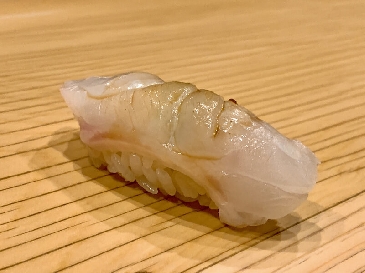

Saw-edged perch (Ara)
【Nigiri sushi: Shiromi】
Sawedged perch (Ara) do not form schools and are naturally scarce. As a result, although they are caught commercially using methods such as line fishing, large catches are difficult to obtain. Market supplies are limited, and large specimens are particularly prized for their exceptional flavor and rarity.
The flesh is white and slightly translucent, with a faint cherry pink hue. It has a firm texture, a clean flavor without any unpleasant fishy odor, and a rich umami taste that pairs well with vinegared rice. It is delicious when served without the skin and seasoned with salt and citrus juice. It is also recommended to prepare the fish using the yushimo technique, in which boiling water is poured over the skin while the flesh underneath remains raw, or the yakishimo technique, in which the skin is lightly seared and then immediately chilled in ice water. Although ara is rarely found even at high-end sushi restaurants in Tokyo, it is more readily available in areas such as Kanazawa and Toyama, where diners have a better chance of enjoying excellent ara nigiri.
Incidentally, although both Ara and Kue are considered premium fish, people sometimes confuse their names. This is because ara is the standard Japanese name for one species, but it is also used as a regional name for kue in areas such as Kyushu. The fish known by the standard Japanese name ara (Niphon spinosus) is a different species from the fish known by the standard Japanese name kue (Epinephelus bruneus).
【What is Ara】
Saw-edged perch (Ara) is distributed on the Pacific Ocean side from Hokkaido to southern Kyushu, on the Sea of Japan side from Aomori to northern Kyushu, and on the Korean Peninsula and the Philippines. It lives in the reef zone at depths of 70 m to 400 m. It is called a "phantom fish" because it is not easily caught.
It has a standard length of about 80 cm, with the largest growing to 1 meter. Ara is not at all like Hata (Sevenband grouper), but more like Suzuki (Japanese sea bass), and is called "Oki-suzuki" in some areas.
Because of its non-swarming habit and small absolute numbers, it is mostly caught occasionally by bottom long line fishing and pole and line fishing.
Large-sized fish are rarely sold in the market, and they are very tasty, making them very expensive fish. Young ones, 20 to 50 cm in length, are abundant along the Japan Sea coast and are consumed mainly in the area of production.
【Substitute fish】
Hapuku wreckfish (Minamaosuzuki): Polyprion oxygeneios (Schneider & Forster)
Cornish salmon or Herring hake: Merluccius merluccius
Patagonian Toothfish (Majeranainame): Dissostichus eleginoides Smitt, 1898
【Related contents】
List of White flesh fish (Shiromi)
(Revision date: October 14, 2026)
Main production area
Ishikawa Fukui Shizuoka Chiba
Season
Winter