

White flesh
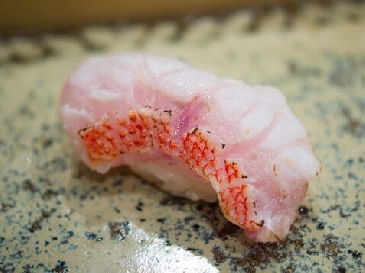

Broadbanded thornyhead (Kinki)
【Nigiri sushi: Shiromi】
The standard Japanese name for this fish is Kichiji (broadbanded thornyhead, Sebastolobus macrochir), but it is commonly known as Kinki. In the past, catches were abundant, and until around 1960, it was primarily used as fertilizer and as an ingredient in sasa-kamaboko (a type of fish cake), a specialty of Sendai. It was considered a low-grade fish. However, in recent years, as consumer preferences have shifted toward fattier fish, its reputation has risen, and it is now considered a high-end fish. Today, it is regarded as being on par with nodoguro in terms of prestige, and its price is similarly high.
Kinki has beautiful skin, and because the area between the skin and the flesh is rich in umami, it is served as nigiri sushi with the skin left on. Searing the fish removes some of its excess fat, giving it a lighter texture, while the aromatic char further enhances its flavor. Although there is no definitive evidence to support this, many sushi chefs appear to pair Kinki with sushi rice seasoned with rich red vinegar.
While it is a beloved staple sushi topping in Hokkaido, it is rarely seen in Tokyo sushi restaurants. Furthermore, I believe that sushi chefs often choose to simmer Kinki simply in water or kombu broth, rather than in a rich sauce made with soy sauce, to make the most of its natural fat content. This is, of course, just my personal opinion.
【What is Kinki】
Kinkii is distributed in the Pacific Ocean off the Pacific coast of Honshu north of Suruga Bay, Hokkaido, and the Kuril Islands, as well as the southwestern part of the Sea of Okhotsk. It is particularly abundant along the Pacific coast of Tohoku and Hokkaido and does not inhabit the Sea of Japan. It measures 30 cm in length and inhabits continental shelf slopes at depths of 150–1,200 meters, feeding on shrimp and small fish.The bright red color of Kichiji is believed to be due to astaxanthin, a pigment found in shrimp. It is considered one of the most delicious red fish, with a delicate, flavorful white flesh that is excellent when served as sashimi. Note that the red color fades and turns orange as the fish spoils.
【Substitute fish】
Shortspine thornyhead (Arasukakichiji): Sebastolobus alascanus Bean, 1890
【Related contents】
List of White flesh fish (Shiromi)
(Revision date: November 4, 2026)