

White flesh
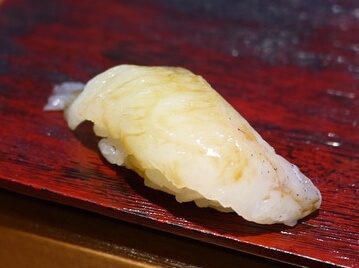

Devil stinger (Oniokoze)
【Nigiri sushi: Shiromi】
The name Devil stinger (Oniokoze, Inimicus japonicus) comes from its hideously ugly, fearsome appearance. Despite its fearsome looks, its beautiful, translucent white flesh has a delicate sweetness and rich umami flavor. Many people consider it even more delicious than winter pufferfish. When preparing it for sushi, the thin skin must be removed, and the flesh is sliced relatively thinly and scored to adjust its texture. Sushi rice seasoned with rice vinegar is generally considered best for bringing out the delicate flavor of the white flesh.
A tiny amount of wasabi is added, and the sushi is shaped gently with a small amount of rice to preserve the fish’s pleasant texture. It is typically served with salt and citrus juice, or with momiji oroshi (grated daikon radish mixed with red chili pepper) and ponzu sauce.
However, because oniokoze has a disproportionately large head, using it exclusively for sushi results in a considerable amount of waste. Whether or not it is appropriate, the soup served at sushi restaurants made from the leftover parts of oniokoze is divine. Even the liver and skin are delicious when briefly blanched, making them excellent accompaniments to alcoholic drinks. This fish is generally found only at restaurants that know how to make good use of these leftover parts.
Finally, many oniokoze available on the market, including live specimens, are sourced from Korea. Izakaya and similar establishments often use the less expensive Korean fish. Since fish caught in Korea can sometimes be mislabeled as domestic during landing or distribution, it is important to buy from a trusted wholesaler to avoid being misled about its origin.
【Also known as】
Lumpfish, Poison fish.
【What is Oniokoze】
Oniokoze (Devil stinger) grows to a total length of about 25 cm. There are cortical protrusions over the entire body that look sharp. It is also a fish that has poison in its dorsal fin, which can cause you big problems if you’re inadvertently stung. It lives in sandy and muddy seafloors from Kanto southward in the Pacific Ocean and from Niigata southward in the Sea of Japan as well as in coastal areas of the East China Sea, from shallow inner bays to depths of up to 200 m. Many people praise it, saying it’s even better than winter fugu.
【Related contents】
List of White flesh fish (Shiromi)
(Previous revision date: January 8, 2024; Current revision date: October 26, 2026)