

Prawn and crab
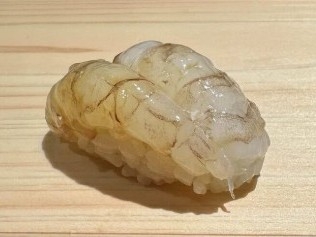
Gasu shrimp (Gasu ebi)
【Nigiri sushi: Ebi/Kani】
Gasu ebi is known as “Echizen ebi” in Fukui Prefecture and goes by various other names depending on the region, including “Doro ebi” (Tajima, Hyogo Prefecture), “Gara ebi” (Fukui Prefecture), “Tora ebi” and “Mosa ebi” (Tottori Prefecture), and “Tsuchi ebi” (Kyoto Prefecture).
Along the Sea of Japan coast, the fishing season for snow crab overlaps with that of gasu ebi, so full-scale fishing for gasu ebi traditionally began only after the snow crab season ended. Once consumed mainly in local communities and relatively unknown elsewhere, gasu ebi has gained recognition in recent years as more people have come to appreciate its flavor. It has become so popular that it sometimes commands higher prices than ama ebi (sweet shrimp).
Gasu ebi has a rich sweetness and a pleasantly firm texture, making it excellent for sashimi and sushi. However, it has one drawback: as freshness declines, enzymatic activity promotes melanin formation, causing the flesh and shell to darken rapidly. For this reason, even traditional Japanese restaurants and high-end sushi restaurants often serve gasu ebi only on the day it is delivered, making it difficult to enjoy it at its freshest. If you visit the Hokuriku region or surrounding areas, be sure to try this delicacy while you have the chance.
In addition to sashimi and sushi, gasu ebi is used in miso soup, simmered dishes, salt-grilled dishes, tempura, and other deep-fried preparations. It is also used as an ingredient in chawanmushi (Japanese steamed egg custard).
【Waht is Gasu ebi】
Gas shrimp (Gasu ebi) are distributed only along the Sea of Japan coast, from Hokkaido to Shimane. Gasu ebi is a common name; the formal names are Kurozako ebi and Togezako ebi. Kurozako ebi primarily inhabits muddy-sandy bottoms at depths of about 200 meters in the Sea of Japan. Its close relative, Togezako ebi, inhabits depths greater than 250 meters, so their habitats differ. Kurozako ebi is about 12 cm long, slightly smaller than Togezako ebi, and has a stockier, more robust body shape.
【Related contents】
List of Prawn (Ebi) and Crab (Kani)
(Revision date: November 10, 2026)
Main production area
Tottori Hyogo Ishikawa
Season
March-June