

White flesh
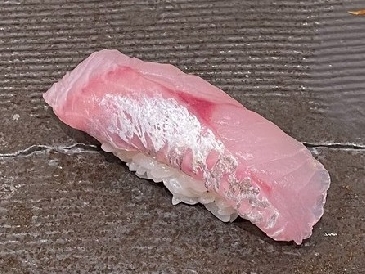
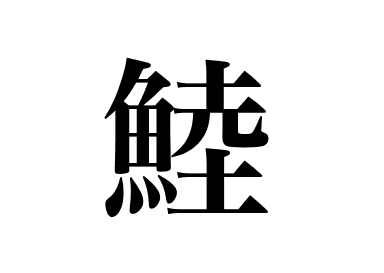
Gnomefish (Mutsu)
【Nigiri sushi: Shiromi】
The flesh of the gnomefish (Scombrops boops, Mutsu) has a faint pink hue and a tender texture. Even smaller ones tend to have a high fat content. While this richness is part of its appeal, some people may find the fish somewhat greasy, making it a matter of personal preference.
It is well suited to dishes such as simmered fish, and in recent years, it has also been used increasingly as a sushi topping. In modern omakase sushi courses, fatty fish such as akamutsu and kinki are often served as a single piece of nigiri or as an appetizer. The peak season for mutsu is winter, and its flavor is said to decline from spring through summer.
At fish markets, it is sometimes called “honmutsu” to distinguish it from other fish with “mutsu” in their names, such as kuromutsu. However, sushi restaurants do not always clearly distinguish between mutsu and kuromutsu, and in some cases, fish sold as mutsu may actually be kuromutsu. Few restaurants serve nigiri sushi explicitly identified as “mutsu,” as distinct from akamutsu or kuromutsu. This reflects the current situation in the sushi market.
*The scientific name for Mutsu is Scombrops boops (Houttuyn, 1782), and the scientific name for Kuromutsu is Scombrops gilberti (Jordan and Snyder, 1901).
【What is Mutsu】
Gnomefish (Mutsu) inhabits the Pacific Ocean, Sea of Japan, and East China Sea from Hokkaido to Kyushu at depths of 200–700 meters. It grows to a maximum length of approximately 60 cm. Compared to Kuromutsu, another member of the Mutsu family, it has fewer lateral line scales.The body is spindle-shaped. The body color is yellowish-reddish-brown in juveniles and dark brown in adults. The eyes and mouth are relatively large, and the teeth are sharp.
【Related contents】
List of Silver-skinned fish (Hikarimono)
(Revision date: November 2, 2026)
Main production area
Nagasaki Kagoshima Chiba
Season
Winter