

White flesh
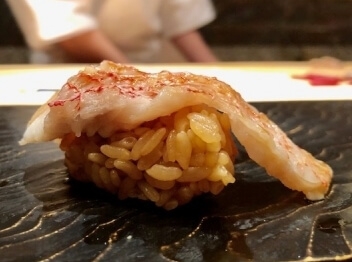

Matsubara red rockfish (Akoudai)
【Nigiri sushi: Shiromi】
Red fillets sold in Tokyo markets under the name “Akou” may include deep-sea Sebastes species with reddish bodies, such as Oosaga (Sebastes iracundus), Sankoumenuke (Sebastes flammeus), and Baramenuke (Sebastes baramenuke). On the other hand, “Ako” and “Akou,” sold in western Japan and Kyushu during the summer refer to the Kijihata (Epinephelus akaara). Additionally, although Akoudai is sometimes written as “red fish” (Akauo), the standard Japanese name “Akauo” actually refers to a different species in the goby family. Originally, the name “Akauo” referred specifically to Akoudai, but today it is also used for closely related species, making fish nomenclature rather complex.
In the past, people used Akoudai as a substitute for tai (red seabream) or tara (cod). However, in recent years, declining catches have made it increasingly rare. Combined with changing consumer preferences, this has helped establish Akoudai as a high-end fish.
Akoudai is characterized by its thick skin and the layer of fat beneath it. The flavor of the filleted flesh improves when it is allowed to rest in the refrigerator for about two to three days. Since the flesh is tender and easily falls apart, marinating it with kombu (kobujime) is also a good option. Additionally, when served as sashimi in the kawashimo-zukuri style, the fat and umami between the skin and flesh can be enjoyed. Although Akoudai is a mild-flavored white-fleshed fish, it has a rich, creamy flavor from its fat and pairs well with vinegared rice. It is suitable not only for simmered dishes and hot pots but also for preparation in sake lees or miso marinades.
However, Akoudai is rarely seen as a nigiri sushi topping at sushi restaurants in Tokyo. This is likely because limited catches and distribution make it difficult to secure a stable supply for sushi restaurants.
【What is Akoudai】
Matsubara's red rockfish (Akoudai) are distributed along the coast from Aomori to Mie. They primarily inhabit rocky reef areas at depths of 500–700 meters along the continental shelf edge. They grow to a length of 50–60 cm. Their body color is uniformly bright red.
【Related contents】
List of White flesh fish (Shiromi)
(Revision date: November 3, 2026)
Season
Winter-Spring