

White flesh
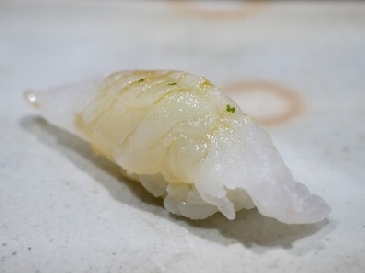

Redspotted grouper (Kijihata)
【Nigiri sushi: Shiromi】
Kijihata (Epinephelus akaara) is commonly known as “Akou” in the Kansai region and is such an essential part of Kansai's culinary culture that people often ask in summer, “Hamo or Akou?” It is primarily caught along the Sea of Japan coast, in the Seto Inland Sea, and in the coastal waters of northern Kyushu. However, catches in the Seto Inland Sea have declined in recent years, and fish caught in the Sea of Japan now account for the majority of the supply to Kansai markets.
Outside these production areas, it rarely appears on ordinary households' dining tables and is considered a rare fish, typically served at high-end traditional Japanese restaurants. It is regarded as one of the most delicious groupers. The wholesale price generally averages around ¥5,000 per kilogram, although it varies considerably depending on the size of the fish.
Larger fish tend to have fattier flesh and are considered more flavorful. Consequently, prices for fish measuring around 40 cm in total length can be more than twice as high. By contrast, smaller fish measuring less than 30 cm are traded at relatively affordable prices.
At sushi restaurants in Kansai, akou is often preferred to makogarei and has become an essential sushi ingredient. Its flesh has a pleasantly chewy texture, and its umami flavor becomes more pronounced the more you chew. It pairs exceptionally well with sushi rice and is characterized by a pleasant aftertaste and an elegant flavor. Furthermore, not only is the flesh delicious when cooked, but the broth made from its bones is also rich in flavor, making the fish versatile in a wide range of Japanese dishes.
However, catches in the Kanto region are limited, and deliveries to Toyosu Market are infrequent. Consequently, opportunities for sushi restaurants in Tokyo to serve it are limited, and it is far less common there than in Kansai.
【Also known as】
Garrupa, Red spotted grouper
【What is Kijihata】
What is Kijihata?
Kijihata (Redspotted grouper) lives in shore reefs at depths of 5 to 25 meters along the coasts and feed on crustaceans and small fish. They live on Japanese coasts from Aomori Prefecture southward, around the Korean Peninsula, Taiwan and China. More are caught on the Pacific Ocean side than the Sea of Japan. They grow to 40 cm long, have somewhat skinny, long bodies and have a red band with spots across the body.
【Related contents】
List of White flesh fish (Shiromi)
(Previous revision date: May 16, 2025; Current revision date: November 5, 2026)
Main production area
Seto Inland Sea Shimane Tottori
Famous production area
Season
Late Spring-Summer