

Shellfish
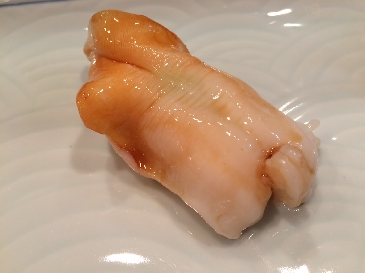

Bering Sea cockle (Ishigakigai)
【Nigiri sushi: Kai】
Bering Sea cockle (Ishigakigai, Clinocardium californiense) begins appearing in markets around the time the torigai season ends—from the end of the rainy season through early summer—and disappears by the end of summer. Because its shipping season is short and its main production areas are limited, it is often sold at high prices.
In recent years, its use in sushi restaurants as a summer alternative to torigai has increased, and around this time of year, you will start to see Ishigakigai used for nigiri sushi. While torigai meat has a dark, almost black appearance, Ishigakigai has a much whiter flesh, which is why it is also known as “Shirotorigai” (“white torigai”). At Toyosu Market, they are traded for approximately 300 to 700 yen per piece. Wild-caught Ishigakigai are a rare commodity that rarely enter the market; when they do become available, they can fetch nearly twice the price of farmed ones.
Ishigakigai are related to torigai and are prized for their crisp, snappy texture. They contain free amino acids such as glycine and arginine, and are characterized by a strong sweetness and umami flavor. They are also highly resilient shellfish that retain their freshness well, surviving for about two to three days even after being removed from the shell. Some sushi chefs use a technique in which they gently tap the shellfish with the palm of their hand just before serving to restore firmness to the flesh, thereby bringing out the elasticity and unique texture of Ishigakigai. This technique is used to maximize the characteristic texture of fresh shellfish.
Ishigakigai can be prepared as sushi either raw or after being briefly blanched. When served raw, you can fully savor the refreshing aroma, juiciness, and crisp bite unique to Ishigakigai. On the other hand, blanching firms the surface just enough, creating a moderate elasticity while further enhancing the sweetness and umami. This results in a milder flavor and a more supple mouthfeel, distinct from the raw version.
【Temperature of vinegared rice (shari) and sushi toppings】
36℃/15~20℃
【Related contents】
List of Shellfish (Kai)