

White flesh
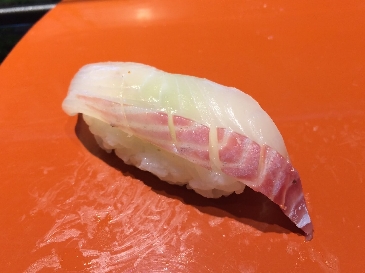
Blackhead seabream (Kurodai)
【Nigiri: Shiromi】
Kurodai is distributed throughout Japan except the Ryukyu Islands, the southern Korean Peninsula, the north-central coast of China, and Taiwan.The total length is about 30 to 50 cm. The coloring on its body is from black to dark gray and the belly side is a silvery white. This is a fish that is called by different names depending on the size of growth. In Kanto it is called Chin-chin, then Kaizu and finally Kurodai, while in Kansai it is called Babatare, then Chinu and then Osuke.
Blackhead seabream (Acanthopagrus schlegelii), known in Japan as Kurodai, is a fish of the Sparidae family characterized by its firm white flesh and rich umami flavor. It is in season during the summer, and Kurodai caught during this season is considered just as delicious as Madai (Pagrus major). Its flesh is tender yet pleasantly firm, without being overly fatty. A refined sweetness spreads across the palate, accompanied by a subtle hint of the sea. However, because Kurodai inhabits inner bays and is omnivorous, some individuals may have a slightly stronger briny aroma. Furthermore, because it is widely distributed along Japan's coasts and is caught relatively consistently, it is not considered a rare fish and is generally sold at a more reasonable price than premium fish such as Madai.
Kurodai's beautiful, translucent white flesh lies beneath its dark skin, so it is generally prepared by removing the skin before being made into nigiri. However, because grilling enhances the skin's toasty aroma and umami, some sushi restaurants intentionally leave the skin on and serve it as yakishimo-zukuri, lightly seared over a flame. To highlight the delicate sweetness and refined flavor of Kurodai, it is recommended to enjoy it not only with soy sauce but also with salt and citrus fruits such as sudachi or kabosu.
In addition to sashimi and nigiri sushi, Kurodai is used in a variety of dishes, including arai (fish briefly rinsed in ice water to firm the flesh), salt-grilled fish, and simmered dishes. It has long been a popular food fish in western Japan, particularly along the coast of the Seto Inland Sea, where it remains a staple ingredient for both nigiri sushi and sashimi.
In contrast, Kurodai has never been held in as high regard in the Kanto region as it has in western Japan. During the Edo period, a senryu poem stated, "Kurodai is a fish that does not belong on a white wooden offering stand (The most appropriate stand for placing offerings to the gods)," suggesting that it was not regarded as an auspicious fish. Furthermore, in some regions, there is a folk belief that pregnant women should not eat Kurodai. In parts of western Kanagawa Prefecture, Madai was traditionally served at celebratory gatherings, whereas Kurodai was offered at funerals and Shinto rituals. Against this cultural backdrop, the association of black with inauspiciousness became deeply rooted. As a result, although Kurodai is abundant in Tokyo Bay, it never became as important a topping in Edomae sushi as Madai.
Even today, relatively few restaurants in the Kanto region serve Kurodai nigiri, while it continues to be highly prized as a sushi topping in the Seto Inland Sea region and Kyushu.
【Related contents】
What is Red Snapper the same as “Tai” (Sea Bream)?
List of White flesh fish (Shiromi)
(Revision date: July 23, 2026)
Main production area
Hiroshima Ehime Aichi Hyogo
Season
Autumn – Winter