

Red flesh
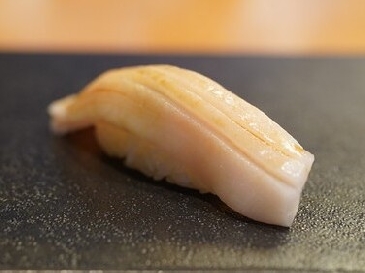

Broadbill swordfish (Mekajiki)
【Nigiri sushi: Akami】
In winter, broadbill swordfish (Mekajiki) is rich in fat, and the part known as “haramo” is particularly fatty. The whitish appearance of the flesh is also due to its high fat content. When you put it in your mouth, the fat melts just right, and the combination of its sweetness and the tartness of the vinegared rice creates an exceptional flavor.
While mekajiki is a staple topping at sushi restaurants around Kesennuma—its region of origin—in Tokyo, it is generally only seen at conveyor-belt sushi restaurants. Additionally, in “Shimazushi” from places such as Minamidaito Island in Okinawa Prefecture, Hachijojima in the Izu Islands, and the Ogasawara Islands, mekajiki is sometimes marinated in soy sauce. The meat, which takes on a tortoiseshell-like color, is then used to make sushi.
Among swordfish species, mekajiki has particularly tender flesh and does not become tough easily even when cooked. As a result, it is suitable not only for sushi and sashimi but also for dishes such as teriyaki and steak. It is a large fish with a high proportion of edible meat, and because it is easy to process into fillets or blocks, it is consistently available on the market as a frozen product. Since it has traditionally been a popular everyday fish, it is relatively affordable and is sold year-round in supermarkets as a common choice. Its flesh is also sometimes used as an ingredient in fish-paste products.
【Related contents】
List of Red flesh fish (Akami)
(Revision date: August 27, 2026)