

Shellfish
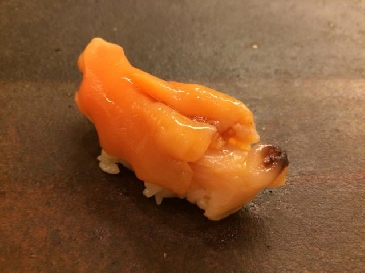

Chinese surf clam (Aoyagi)
【Nigiri sushi: Kai】
Chinese surf clam or trough shell (Mactra chinensis), known in Japan as bakagai, is a bivalve found from Southeast Asia to Japan, inhabiting shallow sandy-muddy bottoms at depths of up to about 20 meters. It grows to a shell length of approximately 8–10 cm. The shell ranges in color from white to pale yellowish brown, with concentric growth lines on its surface. Because the former village of Aoyagi in Chiba Prefecture was once a major production area, the name “aoyagi” became widely used in seafood markets and is still used today in sushi restaurants.
Aoyagi is a signature sushi topping of Edomae sushi, prized for its vibrant orange flesh and distinctive flavor. The flesh is briefly blanched before serving, and Aoyagi with firm, well-shaped tips is considered to be of the highest quality. It has a firm, satisfying texture, and a distinct oceanic aroma spreads across the palate when eaten. In addition to its pronounced sweetness, subtle astringency and bitterness can also be detected, creating a unique flavor profile appreciated by sushi connoisseurs.
Although it pairs exceptionally well with sushi rice, Aoyagi is a topping that divides opinion among diners, and some sushi chefs choose not to include it on their menus.
Its characteristics vary depending on the region. Aoyagi from Tokyo Bay, where it was once abundant, is characterized by its deep orange flesh and rich aroma. In contrast, Hokkaido aoyagi is generally larger and meatier, offering a satisfying bite, but its flesh is paler in color ,and its flavor is more delicate. Mikawa Bay is also recognized as a source of high-quality aoyagi.
Also called Hen clam or Surf clam or Rediated trough-shell.
【Trivia】
Generally, shellfish has trace amounts of taurine, but there are copious amounts in round clam. This is a type of amino acid and is thought to be good for high blood pressure.
【Related contents】
List of Shellfish (Kai)
(Revision date: July 11, 2026)
Main production area
Chiba Aichi Hokkaido Kanagawa
Famous production area
Season
Winter-Spring