

Shellfish
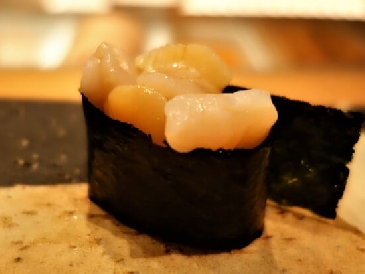
Chinese surf clam adductor muscle (Kobashira)
【Nigiri sushi: Kai】
"Kobashira" refers to the adductor muscle of the Chinese surf clam (Aoyagi). The Aoyagi has two adductor muscles: the larger one is called "Ooboshi," while the smaller one is known as "Koboshi" or "Baraboshi." At markets such as Toyosu Market, they are sorted and sold separately, and such detailed classification is unique to Japan. In contrast, scallops have only one adductor muscle because the other has degenerated.
In the Aoyagi, the adductor muscle (kobashira) is more valuable than the meat itself, and kobashira is prized as a premium sushi topping. Its appeal lies in the delicate sweetness characteristic of shellfish and its crisp texture. It is most commonly served raw as gunkan-maki.
The smaller "Koboshi" is often used in tempura restaurants, while the larger "Ooboshi" is commonly served in sushi restaurants, each being selected according to its particular characteristics.
Kobashira from Tokyo Bay, known as "Edomae," has long been highly regarded for its beautiful, faint orange hue and exceptional quality. However, due to declining catches in recent years, most of the kobashira available on the market now comes from Hokkaido.
While Aoyagi divides opinion because of its distinctive flavor, kobashira is a premium sushi topping loved by many for its delicate sweetness and characteristic crisp texture.
【Points to note when preparing】
When rinsing kobashira, sometimes salt water is used rather than fresh water. It has about 3 to 4% salt concentration, called Tatejio, about the same as seawater. On the other hand, shellfish contain about 0.8% salt. The salt content of raw fish is about 0.2%, so washing with fresh water will not affect the taste. However, when shellfish is rinsed in fresh water, the water penetrates the surface of the shellfish, making it taste watery. Rinsing shellfish in tatejio prevents this from happening.It is not only used to rinse shellfish but to flavor fillets of fish. it does not dehydrate the fish and cause it to shrink, and the salty flavor penetrates the fish evenly.
【Temperature of vinegared rice (shari) and sushi toppings】
36℃/18~20℃
【Related contents】
List of Shellfish (Kai)
(Revision date: July 21, 2026)
Main production area
Chiba Aichi Hokkaido
Famous production area
Season
Winter-Spring