

Squid and octopus

Common octopus (Madako)
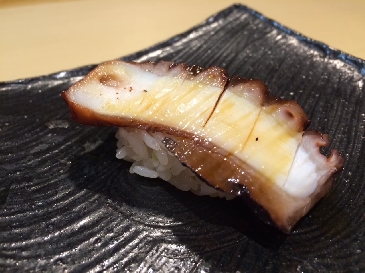
【Nigiri sushi: Tako (Octopus)】
What is Tako?
Tako (common octopus) lives in shallow waters of warm regions throughout the world. Outside of Japan, many keep their distance from this creature, even calling it names like “Devil fish”. Japan accounts for about 60% of the consumption of tako worldwide.
Madako found in Japan is called ‘jidako’ but it is extremely rare and most madako are imported to Japan from Mauritania and Morocco. Compared to jidako, this imported madako is known to be softer and when boiled it turns a vivid red. While Jidako is highly acclaimed for its umami and texture, not only do high-quality jidako that can be found in places like Akashi and Sajima, have firm meat and umami, as well as a unique fragrance.
The lifespan of the Madako is not known, but it is believed to live from one to several years. Then, Madako will breed only once at the end of its life, leaving behind offspring to end its life span. In preparation for this biggest event, it is said that June to July is the best season for this species, when it grows rapidly under its voracious appetite.
Tako has the same sweetness and umami aspects as ika (squid) which comes from its taurine, betaine and glycine. The reason the skin of tako turns red when it’s boiled is that the color of the ommochrome, which exists in the chromatophore of the surface of the skin, changes color.
What does Tako (Common octopus) nigiri sushi taste like?
Even among sushi chefs, it is often said that the true value of the common octopus lies not so much in its intense umami flavor, but rather in its firm texture and satisfying bite. It has a firm yet not overly tough texture, and with each chew, a delicate resistance gradually gives way. This texture is the true charm of octopus, and it is also the element that most clearly reflects the quality of its preparation.
Nigiri made with this type of octopus is often served in the middle of an omakase course. Since its flavor is not particularly strong and it is low in fat, it is said to serve the role of cleansing the palate and naturally bridging the transition to the next piece.
Domestic common octopus is generally called “jidako,” but in recent years, catches have declined, and the industry now relies heavily on imports from countries such as Mauritania and Morocco in Africa. Imported octopus is characterized by softer flesh compared to domestic varieties and a vivid red color when boiled. In contrast, domestic octopus is prized for its perfect balance of umami and texture; particularly high-quality specimens from Kurihama and Sajima have firm flesh and offer not only rich umami but also a distinctive aroma.
Furthermore, octopus from Akashi is known for its exceptionally firm texture—so firm, in fact, that it is said to “stand on its own.” When used in nigiri sushi, decorative incisions are made on the surface, and the flesh is lightly tenderized with the back of a knife to bring out a firm texture and subtle sweetness. On the other hand, octopus simmered in a soft soy sauce-based broth is called “sakurani,” and this dish is also a favorite at sushi restaurants.
【Substitute fish】
Chestnut octopus: Paroctopus conispadiceus (Sasaki, 1917)
【Trivia】
・While octopus caught in the Atlantic Ocean and the Mediterranean Sea are primarily common octopus (Octopus vulgaris), recent genetic studies have shown that the so-called “Madako” found in waters near Japan are actually Asian common octopus (Octopus sinensis). Although they were once treated as the same species, advances in DNA analysis have led to their classification as separate species since the 2010s.
・There are fewer and fewer sushi restaurants that buy live octopus in the market and then boil it themselves recently. The flavor of the octopus is greatly influenced by the boiling method. If boiled for too long, some of the depth of flavor is lost, while if the boiling time is too short, the texture becomes limp.
・At Sukibayashi Jiro, tako is served with coarse salt rather than applying Nitsume (which is otherwise always used for Nimono), in order to keep from overpowering the fragrance of the tako.
【Related contents】
What is Takoyaki?
What is used as a substitute for Madako (Octopus)?
Nori (Dried laver seaweed)
List of Squid (Ika) and Octopus (Tako)
(Revision date: May 19, 2026)
Main production area
Setonaikai Kyushu Mie
Famous production area
Season
Summer・Late autumn