

Simmered
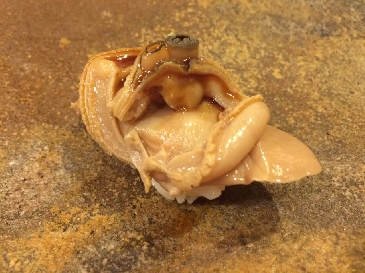
Common orient clam (Nihamaguri)
【Nigiri sushi: Nimono】
What is Hamaguri?
Hamaguri prefer depths of about 10 meters in the sandy and muddy areas of inner bays where freshwater flows into the saltwater. Until the 1960s, Tokyo Bay was famous for digging for hamaguri at low tides. This has been destroyed due to land reclamation, etc. Furthermore, nearly all hamaguri that can be harvested in Japan are open-sea ‘chosen hamaguri’ (common shield-clam), and Japan’s original hamaguri has become somewhat of a fairy tale.
The majority of hamaguri sold on the market nowadays are chosen hamaguri (common shield-clam) imported from South Korea, or shina hamaguri (hard clam) imported from China. Once imported to Japan, they are released to inshore waters and kept as livestock. It is a well-known fact that when clams from Korea are heated, they shrink to pitiful sizes. When Japanese hamaguri are grilled, they swell in size so much it seems like they will jump out of the shells.
What does Nihamaguri (Common orient clam) nigiri sushi taste like?
The common orient clam or Japanese hard clam (Meretrix lusoria or Meretrix lamarckii) was once harvested in abundance in Tokyo Bay and was an indispensable ingredient in Edomae sushi. However, preparing nihamaguri (Nihamaguri is commonly referred to as nihama) is one of the most labor-intensive techniques in Edomae sushi.
First, the tightly closed shells are carefully pried open with a special knife, and the meat is removed without damaging it. Great care must be taken not to tear the thin membrane covering the clam's surface, as even slight damage can affect the plump texture of the finished sushi. This step alone requires considerable skill and experience.
A fundamental principle of Edomae sushi is that clams are never served raw; they are always cooked before being prepared. Because overcooking makes the flesh tough, the clams are gently steamed with sake or briefly boiled, then immediately cooled and cleaned by removing the digestive organs. They are then marinated in a seasoning mixture made with soy sauce, sake, sugar, and other ingredients, allowing the flavors to penetrate the meat. In Edomae sushi, the term ni ("simmered") does not necessarily refer to prolonged cooking, but rather to this traditional process of marinating the cooked clam in a seasoned broth.
Generally, one clam is used to make a single piece of nihama sushi. Sushi chefs carefully select clams of the appropriate size to achieve the ideal balance with the sushi rice. Because each piece requires an entire clam, nihama is one of the most expensive sushi toppings.
Properly prepared nihama is prized for its tender, plump texture and delicate aroma of the sea. With each bite, the natural sweetness and umami of the clam blend harmoniously with the rich flavors of the seasoning.
The final quality of nihama depends greatly on the sushi chef's craftsmanship—from preparing and slicing the clam to shaping the sushi and applying the finishing glaze (nikiri). Nihama is one of the classic Edomae sushi toppings that best embodies the refined techniques and traditions of Edomae sushi.
【Temperature of vinegared rice (shari) and sushi toppings】
36℃/18~20℃
【Related contents】
What is Tsukudani?
List of Nimono, Gyoran and Others
(Revision date: July 10, 2026)
Main production area
Aichi Mie Chiba
Famous production area
Kashimanada Kuwana Funabashi Sanbanze
Season
Spring-Early summer