

Prawn and crab
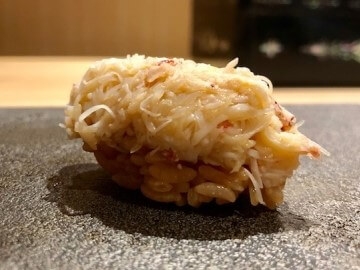
Horsehair crab (Kegani)
【Nigiri sushi: Ebi/Kani】
Kegani (Horsehair crab) is found in various locations along the coast of Hokkaido, south to Ibaraki Prefecture on the Pacific side and to Shimane Prefecture on the Sea of Japan side. It mainly inhabits sandy seafloors at depths of less than 150 m in waters with temperatures of 15°C or lower.
Kegani is delicious both for its meat and its crab tomalley. While it tastes excellent even when simply boiled and eaten as is, extracting the meat from the shell is difficult and time-consuming. Furthermore, even after going to the trouble of removing it, the meat can sometimes be somewhat watery. For this reason, using horsehair crab meat as is in nigiri sushi can leave something to be desired.
That is why sushi chefs take an extra step. First, they boil the whole crab and carefully pick the meat from the shell. Next, they thoroughly remove the moisture from the meat, mix it with the crab tomalley, and shape it into balls of crab meat. When these are used for nigiri sushi, the result is a dish in which the sweetness of the meat is complemented by a concentrated richness and a soft, lingering aftertaste.
On the other hand, with large Kegani, the meat can be neatly removed in large chunks, so it is sometimes used as is for nigiri sushi. In this case, the crab’s natural, deep, and delicate flavor spreads throughout the mouth.
This technique is not limited to Kegani; some sushi restaurants also apply it to other crabs, such as swimming crab.
【Substitute fish】
Helmet crab: Telmessus cheiragonus (Tilesius, 1812)
【Related contents】
What is imitation crab?
Snow crab (Zuwaigani)
King crab (Tarabagani)
List of Prawn (Ebi) and Crab (Kani)
(Revision date: September 11, 2026)
Main production area
Hokkaido Iwate
Famous production area
Season
Spring – Summer (Okhotsk Sea), Autumn (Kushiro Nemuro), Winter (Tokachi)