

White flesh
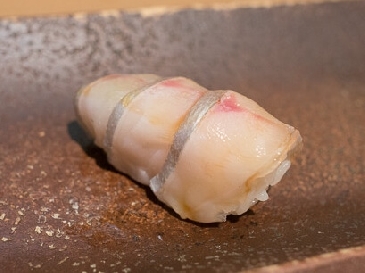

Japanese butterfish (Ibodai)
【Nigiri sushi: Shiromi】
What is Ebodai?
Ebodai is distributed south of Matsushima Bay on the Pacific Ocean side, south of the Oga Peninsula on the Sea of Japan side, and in the East China Sea. Adult fish spend the daytime in the bottom layers at depths of about 200 meters and swim in schools near the surface at night in search of food.It belongs to the family Sparidae and is classified under the order Perciformes. There are 27 species worldwide, with 4 species found in Japanese waters.In the Kanto region, it is called Ebodai, but nationally it is known as Ibodai.
Its body color is silver-gray with indistinct black spots on the gill covers. It can grow up to about 30 cm in length. The scales covering its body are very fragile and easily peel off, so they are often lost during distribution, making it appear smooth-skinned at retail stores. It secretes a sticky mucus from its body surface, which gives it the English name “Japanese Butterfish.”
【The taste of Japanese butterfish nigiri sushi】
Fresh fish caught in the waters of Edo (now Tokyo Bay) were used as toppings for Edomae sushi. One such fish is Ibodai. While the ibodai fish has long been prized in kaiseki cuisine for its rich umami flavor, it is rarely seen as a sushi topping. By gently removing excess moisture, its umami becomes more concentrated; the rich, fatty flavor blends with the moist texture of the flesh, and a well-rounded, natural sweetness spreads across the palate when tasted.
When prepared with the skin on, it is often lightly vinegared to soften the skin and make it easier to eat. By lightly vinegaring ibodai—which is in season during the summer—it becomes a refreshing nigiri sushi that can be enjoyed even during the hot months when appetites tend to wane. While it is uncommon to lightly vinegared whitefish such as ibodai, it is essential to select a fatty specimen and avoid over-marinating it. To ensure the skin does not interfere with the texture, a technique called “kirikake-zukuri” (scoring the skin) is sometimes used.
Alternatively, the fish may be lightly salted, then briefly scalded on the skin side to cool it and remove excess heat, after which the skin is peeled off and the fish is served raw for sushi. In this case, kobujime (kelp curing) is also a good option; the gentle umami of the kombu blends with the rich sweetness of the fat, while the soft notes of vinegar and kombu overlap, creating a piece of sushi that leaves a quiet yet deep aftertaste.
Also called Melon seed or Wart perch.
【Substitute fish】
White warehou: Seriolella caerulea Guichenot, 1848
Black fathead: Cubiceps baxteri McCulloch, 1923
(Revision date: May 9, 2026)