

Simmered
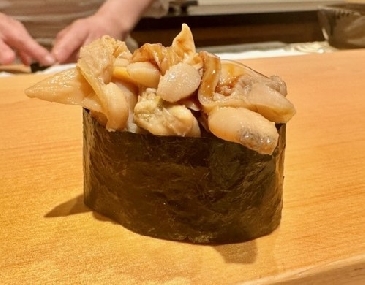

Japanese clam (Asari)
【Nigiri sushi: Nimono】
When using Japanese clams (Asari) for nigiri, since they are smaller than common orient clams (Hamaguri), place about 3 to 5 clams on the rice to make a gunkan-maki, or place the clam meat directly on the shari.
The basic seasoning is the same as that used for simmered asari: they are lightly cooked and then soaked in a sweet-and-salty broth made with sake, soy sauce, and mirin. However, it is important to prevent the meat from becoming tough when heated. To achieve this, lightly cook the clams and then let them soak in the broth, allowing the flavors to penetrate gradually. It is more accurate to think of this as “soaking in the broth” rather than “simmering.”
Because preparing them requires time-consuming work, such as removing the sand, asari sushi is a relatively rare topping.
However, when you chew it, the rich umami flavor of the asari spreads throughout your mouth, making it an exquisite topping that offers an indescribable sense of bliss. Compared with hamaguri, you will likely notice an even stronger shellfish flavor.
In Tokyo, few sushi restaurants serve asari sushi. This is likely due to a decline in asari catches, making it difficult to secure a stable supply, as well as the fact that its cooking method and flavor are similar to those of simmered hamaguri.
Fukagawa-don is a Tokyo specialty, made by lightly simmering Japanese clam (asari) in soy sauce and other seasonings, then pouring the soup over hot rice. Asari-no-sakamushi (Sake-Steamed Clams) is a staple menu item at Izakaya and other restaurants throughout Japan. Tsukudani (preserved food boiled down in soy sauce) is also famous. Bongole, an Italian pasta dish made with clams and other ingredients, is also famous. In other words, it is used in many other dishes, not just nigiri sushi.
【What is Asari】
Japanese clam or Japanese littleneck clam (Asari) is distributed from Hokkaido to Kyushu, as well as around the Korean Peninsula, the Philippines, and Taiwan. It is found mainly in sandy mud, from the intertidal zone of inner bays to depths of several meters. The shell is about 4 cm long. It is egg-shaped, with a rough, fabric-like outer surface, and its pattern varies considerably among individuals. Japanese clams spend their entire lives in almost the same location and are not notably migratory like common orient clams. There are also various theories about the origin of the name “Asari,” including the theory that it comes from asai, meaning “shallow,” because the clam inhabits shallow waters.
Major production areas include Aichi Prefecture and Hokkaido. Japanese clams are in season in spring and fall, when their glycogen and succinic acid levels increase. When selecting live clams in their shells, choose those that respond actively and whose siphons and feet move well. If a clam does not open its shell and the shell has turned a brownish color, it is likely dead.
Domestic production of Japanese clams has fallen to less than 10,000 tons per year. As a result, approximately 25,000 tons of Japanese clams have been imported from China and 10,000 tons from Korea in recent years. Imported clams have been a major source of food-labeling fraud, resulting in frequent problems. This is partly due to a system in which juvenile clams imported from overseas are temporarily grown on Japanese beaches for several weeks and then shipped as if they were domestically produced.
【Related contents】
List of Nimono, Gyoran and Others
(Revision date: September 18, 2026)