

Squid and octopus
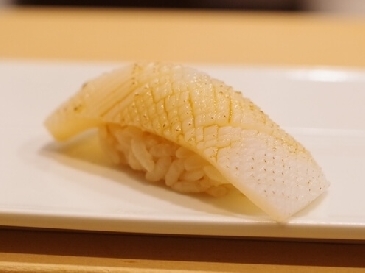

Japanese common squid (Surume ika)
【Nigiri sushi: Ika (Squid)】
Surume ika (Japanese common squid) is found around Japan and from the Sea of Okhotsk to the East China Sea, and its torso is 25 cm or longer. The main spawning sites are from the waters around Kyushu to the East China Sea. Once they are born, they ride the Black Current and the Tsushima Current northward, heading for areas in the sea with abundant food. The schools that hatch in winter are caught in large quantities in the Sanriku, Eastern Hokkaido, and Northern Hokkaido areas, while the schools that hatch in autumn are caught in the open waters of the Japan Sea.
Since surume ika has a slightly firm texture, it is often cut into thin strips with small incisions (kakushi bōchō) when served raw, or sliced finely and shaped into nigiri. The tentacles (geso) are also excellent as sushi toppings when rubbed with salt and briefly parboiled.
In some Edomae sushi restaurants, in addition to serving simmered surume ika as nigiri, a traditional technique known as inrozume—where vinegared rice is stuffed into the body cavity of the simmered squid—is still practiced. A distinctive feature of both preparations is that they are finished with a brushing of nitsume (sweet soy-based sauce).
Squid inrozume is a traditional technique dating back to the Edo period, when nigiri sushi was first established; however, today it is offered by only a limited number of restaurants and is preserved mainly by long-established sushi establishments. In particular, small mugi-ika (young Japanese common squid) caught between May and June are especially well suited for this preparation. Their tender, sweet flesh also makes them highly prized for sashimi and squid rice.
Also called Short-finned squid.
【Note】
They have a high content of low-calorie, high-quality proteins and are rich in taurine, which is thought to have effects of treating fatigue and lowering cholesterol. The liver has high vitamin A content. The free amino acid content of Surume ika is lower than that of other edible squid species. On the other hand, its high trimethylamine oxide and betaine content give it a unique flavor. As the Surume ika can host the anisakis parasite, you must be careful when consuming it raw.
【Related contents】
WHAT IS WA-BOCHO (JAPANESE KITCHEN KNIVES)?
What is used as a substitute for the expensive Mongou ika?
What is Geso?
What is Shiokara?
List of Squid (Ika) and Octopus (Tako)
(Revision date: June 12, 2026)
Main production area
Hokkaido Aomori Toyama Nagasaki
Famous production area
Season
Autumn-Winter