

Silver-skinned
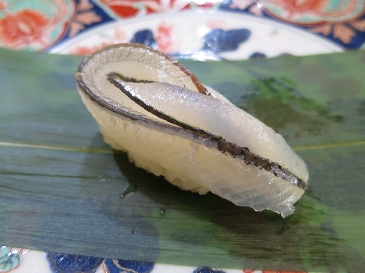

Japanese halfbeak (Sayori)
【Nigiri sushi: Hikarimono】
What is Sayori?
Sayori can be found on all coasts in Japan and live on the surface layer of both inner bays and open seas. Sayori isn’t as blue as saba or aji, but it does have a blue tint to it, so it is considered a ‘hikarimono’ sushi topping.
While the imports from South Korea are increasing, the flavor is impeccable. It is used at conveyor belt sushi restaurants. While the imports from South Korea are increasing, the flavor can’t be called good. It is used at conveyor belt sushi restaurants. When Sayori meat has a cloudiness to it, it means it’s a frozen import from China.
What does Sayori (Japanese halfbeak) nigiri sushi taste like?
Sayori has long been loved in Japan as an ingredient in Edomae sushi, and its arrival heralds the beginning of spring. It has beautiful translucent flesh with a delicate flavor and a distinctive aftertaste.
Traditionally, sayori was salted and marinated in vinegar to remove any fishy odor, but nowadays it is often served raw. Sweet oboro is placed between the fish and the shari. Sayori exceeding 30 cm in length is called kannuki and is highly prized as sashimi because of its rarity. However, many sushi chefs prefer smaller fish, known as katamizuke, for sushi. Some chefs say that kannuki can be very expensive, but its deeper flavor makes it worth the price.
Some sushi chefs prefer to prepare sayori as kobujime. Compared with white-fleshed fish such as hirame, sayori has a slight bitterness and a richer flavor reminiscent of blue-backed fish. For this reason, the flavor of the kombu should remain subtle rather than overpowering. This allows the natural character of sayori to shine through.
When a sushi chef wants to impart a strong kombu flavor to hirame, fresh kombu is often used. However, when preparing sayori, the goal is usually gentle dehydration rather than strong flavor transfer, so kombu that has already been used for kobujime may be preferred. Sayori kobujime is often served with ginger on top, and sometimes with oboro as well.
Although sayori is found in areas such as the Seto Inland Sea, the Hokuriku region, and Wakasa Bay, the Edomae variety from Chiba Prefecture is said to have particularly thin skin and tender flesh. Spring, when the fish gather in shallow waters to spawn, is generally considered the peak season. However, because much of their energy is devoted to reproduction during this period, the flesh can be softer. For this reason, some sushi restaurants regard midwinter, when the flesh is firmer, as the true peak season.
【Temperature of vinegared rice (shari) and sushi toppings】
36℃/18~20℃
【Substitute fish】
Argentinian silverside: Odontesthes bonariensis (Valenciennes, 1835)
Southern garfish: Hyporhamphus melanochir (Valenciennes, 1847)
【Sayori saiku sushi】
Certain toppings in Edomae sushi require detailed knife work and shaping techniques known as “Saiku Sushi” (decorative sushi). One of the most common examples is Japanese halfbeak, or Sayori. This silver-skinned fish is especially valued for its elegant appearance, delicate texture, and translucent flesh, making it an ideal subject for refined presentation.
Sayori nigiri highlights the fish’s natural beauty through a variety of decorative styles. The fillet can be served in a simple elongated form, or transformed through techniques that emphasize movement, line, and curvature. The beautiful pattern on the surface of the skin and the subtle knots created by rolling or twisting the flesh are key visual elements of its presentation.
Common techniques include straight, elongated placement, fine twisting or knotting that creates flowing, wave-like forms reminiscent of wild bracken (warabi), layered arrangements that resemble floral shapes, and gently curved compositions that express motion and negative space. Some styles also involve interlacing or folding the fillet to create depth and structure, while preserving the fish’s natural translucency and silver sheen.
Through these techniques, Sayori becomes more than just a topping—it transforms into an edible expression of seasonal aesthetics and craftsmanship. It is considered one of the most attractive examples of silver-skinned fish in sushi, where simplicity and intricate knife work coexist in perfect balance.
【Trivia】
・Internal organs of the Japanese halfbeak are all black and have a strong smell. Without taking them off carefully during a preparation, it would reduce the deliciousness by half. By the way "someone who is like a Japanese halfbeak" is used to describe someone who is blackhearted contrary to how he looks.
【Related contents】
What is the difference between denbu and oboro?
TYPES OF SUSHI
List of Silver-skinned fish (Hikarimono)
(Revision date: May 30, 2026)
Main production area
Chiba Ishikawa Kagawa Hiroshima
Famous production area
Takeoka Shichigahama Awaji Island
Season
Winter-Early spring