

White flesh
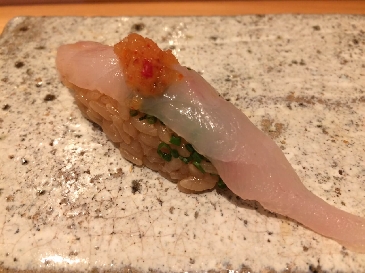

Japanese pufferfish (Torafugu)
【Nigiri sushi: Shiromi】
What is Fugu?
Many fugu live in bays in the western Pacific Ocean and the East China Sea. There are about 50 species of pufferfish caught in the seas around Japan, and 22 species are edible, including Torafugu (Tiger pufferfish), Mafugu (Japanese pufferfish), Shousaifugu (Shousai pufferfish), and Karasufugu (Chinese pufferfish).
The most delicious of these is the Torafugu, which has a pattern on its skin like a tiger. As the ovaries, liver and intestines are toxic, the Fugu can only be prepared by a licensed chef in a licensed facility. In 2012 the regulations for handling Fugu in Tokyo were relaxed, so it is likely it will be used for Edomae sushi in the future.
What does Fugu (Japanese pufferfish) nigiri sushi taste like?
The Japanese pufferfish, torafugu (Takifugu rubripes), is named for its distinctive tiger-like markings and is considered the finest-tasting of all pufferfish species legally approved for consumption in Japan. It also commands by far the highest market price. Since torafugu contains only about 0.3% fat, its flesh is prized for its delicate umami, clean flavor, and elegant finish.
Immediately after ikejime processing, the flesh is quite firm because the lateral muscles contain an exceptionally high amount of collagen—about three times as much as Japanese sardines. For this reason, torafugu is typically aged to develop its umami before being served. When prepared as nigiri sushi, with the fish sliced thinly, each bite delivers a refined, lingering umami.
The most common way to enjoy torafugu is as thinly sliced sashimi, known as fugusashi, which is typically served with ponzu sauce and grated daikon radish mixed with red chili pepper. When served as nigiri sushi, however, it is usually seasoned very lightly with a pinch of salt or a squeeze of citrus such as sudachi or kabosu. Some sushi restaurants also use a small amount of their own homemade ponzu sauce to enhance the fish's natural umami without overpowering its delicate flavor.
The peak season for torafugu is winter, when wild-caught torafugu is considered to be at its finest. However, farmed torafugu is available year-round.
Also called Tiger puffer or Ocellate puffer or Globefish or Blowfish.
【Substitute fish】
Globefish or Blowfish or Puffer: Takifugu porphyreus (Temminck and Schlegel, 1850)
Globefish or Blowfish or Puffe: Takifugu snyderi (Abe, 1989)
Red-eye puffer: Takifugu chrysops (Hilgendorf)
Striped puffer: Takifugu xanthopterus (Temminck & Schlegel,1850)
Globefish or Blowfish or Puffer: Takifugu stictonotus(Temminck and Schlegel,1850)
Half-smooth golden pufferfish: Lagocephalus spadiceus (Richardson, 1845)
Takifugu chinensis (Abe, 1949)
【Related contents】
Types of Fugu cuisine
What is Shirako?
What is Fugu poison?
Why is Fugu so delicious?
List of White flesh fish (Shiromi)
(Revision date: June 30, 2026)
Main production area
Nagasaki Fukuoka Ehime Yamaguchi
Famous production area
Season
Winter