

Silver-skinned
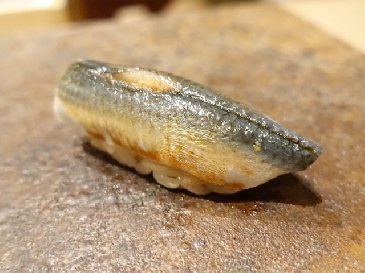

Japanese scaled sardine (Mamakari)
【Nigiri sushi: Hikarimono】
In Okayama Prefecture, sappa—a fish belonging to the same family as kohada—is called “mamakari (Sardinella zunasi)” and has been eaten for generations. The name “mamakari” is said to derive from the fact that it is so delicious that people eat so much rice that they end up borrowing “mama” (the Japanese word for rice) from their neighbors. “Mamakari zushi,” served with vinegared rice, is one of Okayama’s signature local dishes.
Both kohada and mamakari are small fish with many fine bones, and both develop a richer flavor when cured with salt and vinegar. However, there is a significant difference in their status within the world of sushi. Kohada has become firmly established as a signature topping in Edomae sushi, and the techniques for preparing it as a sushi topping are well established. It has a large market, supported by a commercial distribution network that includes processed products. Mamakari, on the other hand, has become firmly established as a regional specialty of Okayama and the Seto Inland Sea. Although it is used in dishes such as mamakari zushi, it has not yet become a common sushi topping at restaurants nationwide.
Mamakari nigiri is characterized by a refreshing flavor in which the umami of the fish blends with the tartness of the vinegar and the subtle sweetness of the vinegared rice. It can be eaten as is, but adding a small amount of wasabi or ginger gives it an even cleaner aftertaste. Mamakari marinated in a sweet vinegar with kelp has a mellower flavor, as the umami of the kelp complements the tartness of the vinegar.
【Related contents】
List of Silver-skinned fish (Hikarimono)
(Revision date: September 25, 2026)
Main production area
Okayama
Season
Autumn-Winter