

Red flesh
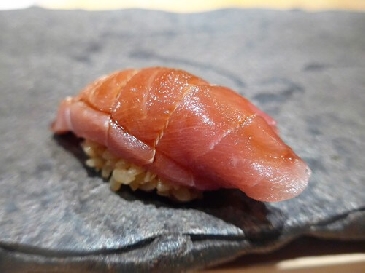

Medium Fatty Tuna (Chutoro)
【Nigiri sushi: Akami】
Tuna is classified into “toro” and “akami” based on the fat content and quality of the meat.
Toro is primarily taken from the belly section. In the sushi industry, the head end is called “kami,” the tail end is called “shimo,” and the belly section is further divided into “hara-kami” (near the head) and “hara-naka” (the center). Toro taken from these sections is classified as “otoro” or “chutoro” depending on the amount of fat.
Chutoro generally has a fat content of about 15–20%, making it less fatty than otoro. It is characterized by a smooth, melt-in-the-mouth texture. Since the fat is not overpowering and harmonizes well with the umami and sweetness of the lean meat, it has a well-balanced flavor.
Chutoro is taken not only from the belly but also from the middle of the back. This part is called “se-toro,” “sho-toro,” “sankaku,” or “wakare-mi.” The term “shotoro” is said to have been first used by Ryuichi Yui, the third-generation owner of the renowned Kizushi restaurant in Ningyocho, Tokyo.
Se-toro is a rare cut located between the muscles that move the dorsal fin and the subcutaneous fat. It offers the richness, acidity, and aroma of lean meat, combined with the sweetness of fatty tuna. However, high-quality se-toro is extremely scarce, with only a few hundred grams available from a single bluefin tuna.
Furthermore, among chutoro cuts, “chiai (bloodline)-gishi” is particularly highly regarded. Located near the bloodline, it has a strong aroma and rich umami flavor. It features a beautiful color transition from lean meat to fatty tuna, and its fine texture melts in the mouth.
【Temperature of vinegared rice (shari) and sushi toppings】
38~40℃/20~25℃
【Related contents】
TYPES OF TUNA
You know toro tuna and akami, but have you heard of the more rare parts of the tuna?
What are Meji , Chubou and Maguro?
Tuna and pickled radish roll (Torotaku maki)
What makes good quality Kuromaguro?
List of Red flesh fish (Akami)
Do you know what kind of Tuna you’re eating at a sushi restaurant?
(Revision date: May 21, 2026)