

Shellfish
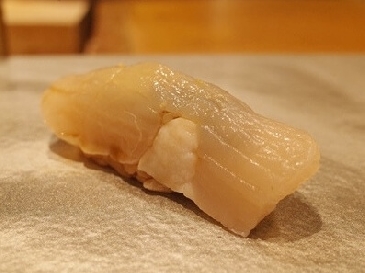
Pen shell (Tairagi)
【Nigiri sushi: Kai】
Pen shell (Atrina pectinata japonica), known as Tairagi in Japan, is found in the warm waters of the western Pacific, including the coasts of Japan from southern Hokkaido to Kyushu, as well as the Korean Peninsula, China, and Taiwan. It inhabits sandy-muddy bottoms at depths of about 5 to 50 meters. The shell typically measures 20 to 30 cm in length, with large specimens exceeding 40 cm, making it one of Japan's largest bivalves. Its shell is elongated and triangular, with a blackish-brown exterior and a silvery-white, pearlescent interior.
When you cut into the adductor muscle of Tairagi, the cross-section reveals fine irregularities and a fibrous pattern. This unique texture serves as an indicator of the Tairagi's freshness. When eaten, it offers a crisp, satisfying bite accompanied by a subtle briny aroma, an elegant sweetness, and a faint astringency that lingers on the palate, allowing you to appreciate the complex flavor unique to Tairagi.
When served as sushi, Tairagi's distinctive and complex flavor is further enhanced, allowing you to fully appreciate its delicate taste. In addition to enjoying it raw, cutting it into thick slices and lightly searing them adds a toasty aroma and brings out its natural sweetness even more. While it pairs perfectly with soy sauce and wasabi, serving it with salt or a squeeze of citrus offers a different yet equally enjoyable flavor experience. By contrast, the mantle or fringe is generally considered less desirable than that of the scallop and is therefore not as commonly used as a sushi topping.
In recent years, Tairagi catches in Japan have declined, and imported products, particularly from South Korea, have become increasingly common on the market. Compared with domestically harvested Tairagi, South Korean Tairagi often has a whiter shell and adductor muscle, and its texture tends to be slightly softer.
Although the standard Japanese name is “Tairagi,” it is sometimes referred to as “Tairagai” in the fields of cooking and food introduction.
Also called Fan shell.
【Temperature of vinegared rice (shari) and sushi toppings】
36℃/15~20℃
【Trivia】
The reason why shellfish is so delicious is the glutamic acid and inosinic acid content, but pen shell also contains high amounts of glycogen (a polysaccharide), which enhances the umami flavor.
【Related contents】
Nori (Dried laver seaweed)
List of Shellfish (Kai)
(Revision date: July 16, 2026)
Main production area
Setonaikai Mikawawan
Famous production area
Season
Winter-Early spring