

White flesh
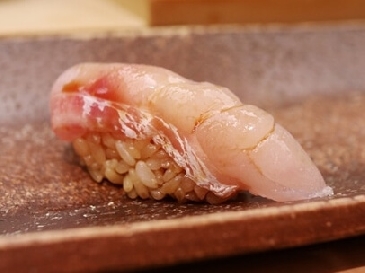
Red horsehead (Akaamadai)
【Nigiri sushi: Shiromi】
Red horsehead (Akaamadai) is known as “Guji” in the Kansai region, particularly in Kyoto, and is recognized as an indispensable fish in Kyoto cuisine. Larger specimens command higher prices, with some especially large ones selling for over 10,000 yen per fish.
Because the tender flesh of akaamadai is prone to spoilage when transported fresh from its source in Wakasa to Kyoto, it was traditionally lightly salted to firm up the flesh. In Kyoto, the term “guji” originally referred to akaamadai that had been salted in this manner. In other words, akaamadai that had been salted was traditionally called “guji.” Today, however, with the advancement of refrigerated transport, akaamadai is no longer salted for shipping.
Also known as the “lady of white-fleshed fish,” akaamadai becomes rich in fat when in season, and its subtle sweetness gradually spreads across the palate. Its high-quality flesh is milky white with a faint pinkish hue and has a translucent quality. However, since it is also a fish with a high water content, it is important to prepare it by removing excess moisture to concentrate its umami. It is sprinkled with salt and left for 30 minutes to an hour, then rinsed to remove the released moisture and salt before use. Removing the moisture in this way brings out the umami and sweetness more clearly and gives the fish a rich, velvety texture.
While akaamadai can be used as-is for sushi, it can also be blanched or lightly seared with the skin on before being shaped into nigiri. It is also sometimes marinated in kelp. However, in Tokyo, akaamadai is more commonly found in Japanese restaurants than in sushi bars, and it is considered a high-end fish, often served as “Wakasa-yaki” or “Matsukasa-age.”
Other names: Horsehead, Horsehead tilefish, Japanese horsehead fish, Red tilefish
【What is akaamadai】
Aka-amadai is called “Guji” in the Kansai region and is a vital part of Kyoto cuisine. In sushi restaurants, Aka-amadai is shortened to Amadai. It is one of the wateriest fish, so it is important to prepare it by removing excess water and concentrating the umami. Sprinkle salt on the fish and let it sit for about 30 minutes to an hour. Then rinse off the water and salt that has come out before using.
【Substitute fish】
・Kingklip comes from the open waters of South Africa. Their bodies reach lengths of 1.5 m and they live up to 500 m deep in the sea. The appearance is completely different from Amadai, but due to the fact that it is a white fish with low fat content and a light, delicious flavor, it can masquerade as Amadai. This fish is extremely popular for consumption in Argentina and Chile. In Japan, Amadai is enjoyed either grilled with salt or steamed. On the other hand, Kingklip is prepared in a western style, either fried or prepared as meuniere. There was a time when it was presented as “Aburi Amadai” or “Kobujime (Kelp-marinated) Amadai” at conveyor belt sushi.
・Warty dory (Allocyttus verrucosus (Gilchrist, 1906))
【Related contents】
What is Shirakawa?
List of White flesh fish (Shiromi)
(Revision date: September 22, 2026)
Main production area
Yamaguchi Fukui Ishikawa Shimane
Famous production area
Season
Autumn-Winter