

Shellfish
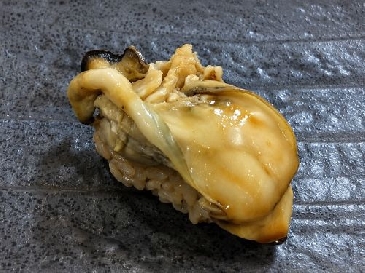

Rock oyster (Iwagaki)
【Nigiri sushi: Kai】
When people think of oysters, many probably think of a winter delicacy. However, that mainly refers to the Japanese oyster (magaki). While most magaki available in the market are farmed, rock oysters (iwagaki) are primarily harvested from the wild.
Iwagaki are also known as “summer oysters,” and their peak season runs from early summer through summer. Before spawning, their flesh becomes plump, and they accumulate abundant glycogen, allowing you to enjoy their rich umami flavor and creamy texture.
Wild iwagaki grow more slowly than farmed magaki, so their large size and thick flesh characterize them. Because they grow on rocky reefs exposed to strong waves, their flesh has a pleasant firmness. Beneath their rich depth of flavor, you can detect an elegant sweetness and a subtle saltiness. Due to their rich flavor, they are also known as “the cheese of the sea.”
The flavor of iwagaki also varies by region. Those from the northern Sea of Japan (Yamagata and Niigata) are rich in minerals and have firm flesh, while those from the central Sea of Japan (Ishikawa and Kyoto) offer an excellent balance of sweetness and depth of flavor. The western Sea of Japan (Shimane and Tottori) is characterized by a mellow sweetness, while those from the Pacific coast (Miyagi, Iwate, etc.) offer a rich briny aroma and a clean finish. These distinct characteristics arise from differences in their growth environments, such as water temperature, salinity, and the types of phytoplankton they feed on.
At sushi restaurants, iwagaki are often served not only as sushi toppings but also as raw oysters in their shells. When enjoyed in the shell, they are commonly served with citrus fruits such as lemon or sudachi, or with ponzu sauce, allowing diners to savor the oyster’s natural flavor.
When served as sushi, some restaurants lightly steam or gently cook iwagaki at low temperatures to bring out their umami, while others prepare raw iwagaki meat as gunkan-maki. Since iwagaki are naturally salty, raw iwagaki gunkan-maki are generally eaten without soy sauce; instead, a light squeeze of citrus is added to enhance their flavor. Furthermore, because the oyster’s moisture can make the nori soggy and affect the texture, it is best to eat them immediately after they are served. Prepared as sushi in this way, the subtle acidity of vinegared rice complements the rich umami of iwagaki, creating a dish with a pleasant and lingering finish.
【Related contents】
List of Shellfish (Kai)
Main production area
Niigata Ishikawa Shimane Tottori
Season
Early Summer – Summer