

White flesh
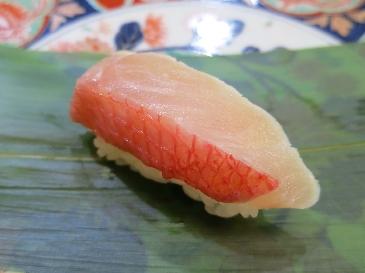

Splendid alfonsino (Kinmedai)
【Nigiri sushi: Shiromi】
What is Kinmedai?
Kinmedai (Splendid Alfonsino) is characterized by its bright crimson body and large golden eyes. Because it lives in deep seas at depths of more than 200 meters it was rarely caught before technology became more advanced. The umami of its fat is appealing and it joined the list of popular toppings about 20 years ago.
Kinmedai used by sushi restaurants is wild caught in the waters around Japan. The best kinmedai is caught by pole-and-line fishing off the coast of Choshi and around the Izu Islands.
On the other hand, most imported kinmedai are caught in New Zealand waters and the Indian Ocean. When New Zealand fishing vessels catch Kinmedai, they dress the fish after removing the heads and entrails on board and freeze them before sending them to Japan. The country exports more than 90% of its Kinmedai catch to Japan. Most of the Kinmedai from the Indian Ocean also go to Japan. These are processed products such as dried fish.
What does Kinmedai nigiri sushi taste like?
Although Splendid alfonsino (Kinmedai) has a name similar to “Tai,” it is a deep-sea fish entirely distinct from the red seabream (Tai). Once considered a fish with high water content that was difficult to prepare, its reputation has grown thanks to careful post-harvest handling and traditional Edo-style preparation techniques, and it is now widely recognized as a premium fish.
In terms of fat quality, the Splendid alfonsino ranks among the fattiest of white fish. However, what matters most in sushi is not the quantity of fat itself, but its quality and overall balance. If the fat is too strong, it can lead to heaviness and a cloying aftertaste; therefore, it is essential to prepare the fish through specific techniques rather than using it as-is. Processes such as “kobujime” (curing with kelp) to draw out umami, “yakishimo-zukuri” (lightly seared) to impart aroma and definition, “kawashimo-zukuri” (skin-seared) to refine the texture of the skin, or “zuke” (marinating) to allow the flavors to meld are not done to reduce the fat, but rather to bring the fish as a whole into a state suitable for nigiri.
Regarding fat quality, the term “Toro kinme” refers to particularly well-marbled specimens among large Splendid alfonsino primarily landed around the Izu Peninsula. Individuals that have grown slowly in deep waters accumulate more fat in their flesh; this fat is characterized not by its weight, but by a delicate sweetness. When served as sashimi or nigiri, it offers a melt-in-the-mouth texture accompanied by an elegant richness, leaving a long-lasting aftertaste despite being a white fish.
When served as nigiri, Splendid alfonsino pairs well with slightly warmer sushi rice, allowing its fat and umami to come through more naturally. It also pairs well with rich vinegared rice, such as that made with red vinegar. For this reason, sushi restaurants that primarily use light rice vinegar may not feature it prominently, as it does not align with their desired flavor profile.
【Temperature of vinegared rice (shari) and sushi toppings】
36~38℃/20~23℃
【Substitute fish】
Warty oreodory (Oomematoudai): Allocyttus verrucosus (Gilchrist,1906)
【Related contents】
When does Kinmedai taste the best?
What is Pacific barrelfish (Medai) sushi?
What is Torokinme?
Nanyokinme
List of White flesh fish (Shiromi)
(Revision date: May 20, 2026)
Main production area
Chiba Kanagawa Wakayama Nagasak Shizuoka
Famous production area
Season
Winter