

White flesh
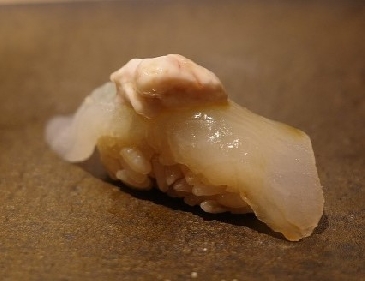

Threadsail filefish (Kawahagi)
【Nigiri sushi: Shiromi】
The flesh, which contains just the right amount of fat, has a firm, springy texture and a refined flavor without any strong aftertaste. When thinly sliced and topped with a small amount of Kawahagi liver, whose rich umami complements the flesh, it creates an exceptional taste experience. It is typically served with scallions or grated daikon radish mixed with red pepper, along with ponzu sauce. When eaten without the liver, paired with a citrus fruit such as sudachi and a sprinkle of salt, the flesh’s subtle sweetness can be appreciated more fully.
Among seafood livers, Kawahagi liver has relatively little fishy odor and is easy to eat. The liver of live fish is served raw, while liver from fish obtained by other means is boiled before being used in sushi. Farmed Kawahagi tend to have larger, fattier livers, and farmed Kawahagi from Oita Prefecture, for example, can be quite expensive. At the market, you can sometimes see sushi chefs feeling the belly of a Kawahagi to check the size of its liver.
At sushi restaurants, Threadsail filefish (Kawahagi) is one of the ingredients that signals the arrival of winter. It sometimes appears on the menu as early as October, making it a piece to savor as autumn deepens.
【Alternate names】
File fish, Fringed Leatherjacket, Porky, Fool fish
【What is Kawahagi】
Kawahagi inhabits shallow waters with sandy bottoms and rocky reefs, including the seas around Hokkaido and farther south, as well as the East China Sea. It grows up to 30 cm in length and has hard, fine scales and thick skin. Its Japanese name comes from the fact that the fish must be eaten after its skin is removed. The skin is so tough that it can be used as a natural file. Compared with Umazurahagi (Black scraper), it is called Maruhage because of its rounded body.
There is no single major production area for filefish, but relatively large quantities are caught along the Sea of Japan coast. Filefish are caught using traps, set nets, and gill nets, but they are not usually caught in large quantities at once. This is because filefish do not swim in schools; instead, they live and move independently. They are often caught as bycatch when other fish are targeted.
【Temperature of vinegared rice (shari) and sushi toppings】
36~38℃/20~22℃
【Related contents】
What is Black scraper (Umazurahagi) sushi?
List of White flesh fish (Shiromi)
(Revision date: September 19, 2026)
Main production area
Chiba Kanagawa Oita Mie
Famous production area
Season
Late autumn-Winter