

Red flesh
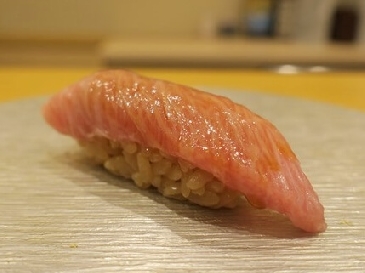
Very Fatty Tuna (Otoro)
【Nigiri sushi: Akami】
It is said that the proportion of otoro obtained from a single tuna is less than 1% of the total yield. Otoro is a fatty cut located primarily on the belly near the head; its fat content ranges from 25–30% and can reach up to 40% during the winter season.
The term “toro” originally referred to the texture of tuna flesh, and “otoro” has traditionally been used primarily for bluefin tuna and southern bluefin tuna. It was once believed that otoro could not be obtained from bigeye tuna; however, in recent years, the term has come to be used more broadly for particularly fatty cuts in general.
Bluefin tuna otoro includes a section called “jabara,” where sinew and fat are layered in a zigzag pattern. The white sinew can affect texture in the mouth, so it is aged in cold storage for several days to achieve a melt-in-the-mouth texture. On the other hand, if aging is allowed to progress too far, the color may deteriorate and the flesh may become overly soft, making it unsuitable for nigiri.
Additionally, “shimofuri” is a rare cut characterized by minimal sinew, evenly distributed fat, and a smooth mouthfeel.
From the “kama” (the area behind the gills near the pectoral fins), a particularly fatty cut called “kamatoro” is obtained. Raw kamatoro is often served without searing to highlight its melt-in-the-mouth texture.
As a general rule, shimofuri should be sliced slightly thinner, while softer cuts should be sliced slightly thicker. The rice (shari) is shaped at a slightly higher temperature—around 40°C—to allow the fat to melt at the optimal point. Since the fat tends to dull the effect of wasabi, a slightly larger amount is often used.
The fats contained in otoro are said to soften perceptions of sourness and bitterness. It is also said that the intake of these fats triggers the release of beta-endorphins, leading to a sense of comfort and mild euphoria. For this reason, otoro is sometimes described as having a highly appealing, almost addictive flavor.
【Temperature of vinegared rice (shari) and sushi toppings】
38~40℃/20~25℃
【Related contents】
TYPES OF TUNA
You know toro tuna and akami, but have you heard of the more rare parts of the tuna?
What are Meji , Chubou and Maguro?
What makes good quality Kuromaguro?
Do you know what kind of Tuna you’re eating at a sushi restaurant?
List of Red flesh fish (Akami)
(Revision date: May 22, 2026)