

Prawn and crab
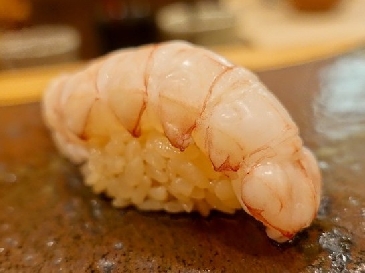

Japanese lobster (Akaza ebi)
【Nigiri sushi: Ebi/Kani】
The meat of the akaza ebi (Metanephrops japonicus, Japanese lobster) is tender and delicious, and it commands a high price. It is similar to the French langoustine and Italian scampi and can be enjoyed in a variety of ways, both raw and cooked, including as sashimi, boiled in salted water, sautéed, or served in pasta dishes.
Akaza ebi is prized as a sushi topping for its rich sweetness and creamy texture. Although delicious when boiled, it is often served at sushi restaurants as “odori” (live) or lightly seared on the surface, keeping the flesh close to its raw state. However, it loses its freshness quickly, making careful freshness management essential. Because catches are limited, distribution beyond the local fishing areas is scarce, and akaza ebi is rarely seen at sushi restaurants in Tokyo.
For those determined to try it, options are limited, but Gamagori City is a good place to visit. Akaza ebi is promoted as a local specialty, and efforts are underway to establish it as a regional brand. Wild-caught akaza ebi are still landed around Mikawa Bay and served at local restaurants and inns.
【Waht is Akaz ebi】
Akaza ebi is distributed along the upper continental slope from the Boso Peninsula to the Hyuga-nada off eastern Kyushu. It inhabits muddy seabeds at depths of 200 to 400 meters. Its body is yellowish-red, with a complex pattern of raised ridges on its carapace. It grows to approximately 20 cm in body length.
It is endemic to Japanese waters. Closely related species include the sculpted lobster (Sagami akaza ebi) and the red-banded lobster (Minami akaza ebi), both of which are also consumed as food. Because of its long, slender claws, it is sometimes called “tenaga ebi” (long-armed shrimp) at restaurants. However, the standard Japanese name “tenaga ebi” refers to an entirely different species of shrimp that inhabits brackish and freshwater environments.
【Related contents】
List of Prawn (Ebi) and Crab (Kani)
(Revision date: November 9, 2026)
Main production area
Shizuoka Chiba Aichi
Season
Autumn-Winter