

Red flesh
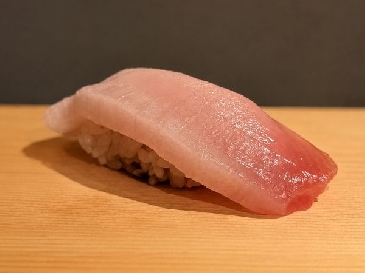
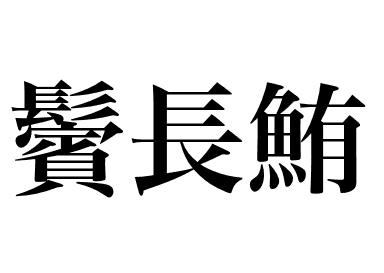
Albacore (Binchou maguro)
【Nigiri sushi: Akami】
This is the smallest of the tuna with a length of about 1.2m and a weight of 40kg. Binnaga maguro (Albacore tuna) is found from temperate to tropic regions all over the world and mainly southward of the Tohoku regions of Japan. They are sometimes found in the southern part of Hokkaido, but it is rare to see them in the Japan Sea. The fishing sites in the Pacific Ocean are the southeastern seas of Japan, the coast of North America and the open seas of the South Pacific Ocean. Around Japan, the long line fishing method and Ipponzuri* are mainly used. The color of the meat is a soft pink and it is soft, so it wasn’t considered to be suitable for sashimi, but lately, more fatty meat is used for both sashimi and sushi toppings. The source of canned tuna is called white tuna and it is of superior quality to the light canned tuna made from Kihada maguro. Canned tuna in oil is used for salad and sandwiches. Also, since the meat doesn’t harden when heated, it is preferred for steak and teriyaki. The wholesale price of albacore tuna (frozen) at Toyosu Market is 3.5 to 4.0 US dollars per kilogram.
*Ipponzuri (Catching fish with fishing poles)
This method has the longest history and uses a pole of 4 - 6 meters to fish from a boat. Using a machine that winds up lines automatically and also using human hands, pulls up tuna.
What does Bintoro (Albacore toro) nigiri sushi taste like?
In the past, albacore (Binchou maguro) was rarely used as a sushi topping. However, its popularity skyrocketed when conveyor-belt sushi chains began serving its fatty belly meat as “Bintoro.” Bintoro has a whitish appearance due to its fat content, a rich sweetness, and little acidity. This makes it easy to eat and widely appealing. Today, it has become one of the most iconic and popular toppings in conveyor-belt sushi.
Albacore’s lean meat is paler in color and lower in fat than that of bigeye tuna. On the other hand, the toro (fatty) portion contains abundant fat, offering a melt-in-your-mouth texture. Off the Sanriku coast, fatty albacore tuna are landed from September to November. The highest-quality specimens are known as “Toro Binchou.”
Furthermore, efforts are underway to establish a brand for albacore tuna in Nachikatsuura, Wakayama Prefecture. Nachikatsuura is known as one of Japan’s leading producers of fresh tuna. Its flagship brand is “Mochi Binchou.” This refers to high-quality fish selected from among the albacore tuna caught by longline fishing in nearby waters—only a few out of every hundred are chosen. Its most distinctive feature is its mochi-like elasticity and chewy texture. Additionally, because its pale pink flesh resembles cherry blossoms, it is also locally known as “Sakura Binchou.”
【Related contents】
Types of tuna
You know toro tuna and akami, but have you heard of the more rare parts of the tuna?
Do you know what kind of Tuna you’re eating at a sushi restaurant?
List of Red flesh fish (Akami)
(Revision date: May 27, 2026)