

Silver-skinned
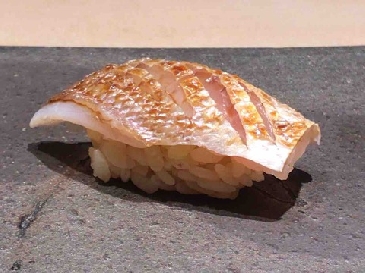

Juvenile crimson seabream (Kasugo)
【Nigiri sushi: Hikarimono】
The origins of Edomae sushi can be traced to the abundant seasonal seafood harvested from Tokyo Bay. In the early days, most sushi vendors operated small street stalls and could not afford expensive fish. Instead, they relied on locally available small fish, many of which were known as zako (small fish) and were considered to have little market value. Sushi chefs transformed these humble ingredients through traditional Edomae techniques such as curing with vinegar, salting, or marinating with kelp, and served them as nigiri sushi.
From a modern perspective, this practice can be seen as an early example of sustainable seafood utilization. By making effective use of underutilized and low-value fish, Edomae sushi embodied principles that closely align with today's efforts to reduce waste and make better use of marine resources.
Small fish are generally characterized by numerous fine bones, a low yield of edible meat, and relatively little fat, resulting in a delicate flavor. For these reasons, they are often overlooked by restaurants and tend to command low prices at the market. However, in the hands of a skilled sushi chef, these fish can be transformed into something truly exceptional. By carefully removing the fine bones and applying preparation techniques suited to their delicate flesh, chefs bring out the fish's hidden umami, creating a refined and elegant taste. One of the best examples of this craftsmanship is Kasugo.
Kasugo, or Kasugo-dai, originally referred to the juvenile form of the crimson seabream (Chidai). Today, however, the term is also used for juvenile red seabream (Madai) and juvenile yellowback seabream (Kidai). These fish are typically about 10 centimeters in length. The name is believed to derive from Kasukko, an old Japanese word meaning “the youngest child.” Because the term referred to the youngest child in a family, it gradually became associated with these tiny seabream and eventually evolved into the word “Kasugo.”
One of Kasugo’s greatest attractions is its delicate cherry-blossom pink coloration, which evokes the arrival of spring. Beneath its soft skin lies a subtle sweetness and delicate umami that gently spreads across the palate. Although Kasugo is a white-fleshed fish, it is traditionally marinated in vinegar before being served as sushi. As a result, it is often grouped alongside hikarimono in Edomae sushi—a category of fish known for their shimmering silver skin, many of which have blue backs.
Although Kasugo is available throughout the year, spring is undoubtedly its finest season. Its name literally means “child of spring,” and its elegant appearance and delicate flavor perfectly capture the spirit of the season.
【Temperature of vinegared rice (shari) and sushi toppings】
36~38℃/20~23℃
【Substitute fish】
Canary chidai (Bluespotted seabream): Pagrus caeruleostictus (Valenciennes, 1830)
【Related contents】
List of Silver-skinned fish (Hikarimono)
(Revision date: June 1, 2026)
Main production area
Nagasaki Ehime Hyougo Fukuoka
Famous production area
Season
Spring